




Five activists convicted of criminal damage after targeting a Barclays bank in Burnley will not have their offences treated as having a “terrorist connection,” despite prosecutors previously seeking to have them sentenced under terrorism legislation.
The five direct action activists, known as the Barclays Five, were convicted of causing more than £200,000 worth of damage to a Barclays bank branch in Burnley in August 2024.
Brendon O’Hagan, Amanda Kelly, Hmeera Atiqnisar, Mohammed Malik and Alma Yaniv smashed windows and threw red paint at the branch, causing an estimated £212,000 worth of damage. The action targeted Barclays over its financial links to Elbit Systems, Israel’s largest arms manufacturer amid a genocide happening in Gaza.
The case had sparked major concern among civil liberties and human rights groups after prosecutors sought to have the defendants sentenced on the basis that their offences had a “terrorist connection”, due to the UK’s proscription of Palestine Action as a terror group back in July 2025.
Such a finding could have had serious consequences for the five, potentially resulting in harsher sentences and additional restrictions following their release.

However, the court has now ruled that the Burnley attack will not be treated as terrorism.
According to the Lancashire Telegraph, the five defendants said collectively following the result: “We are extremely relieved that the court has seen sense and decided not to sentence us as terrorists; this should never have been an option. We were on trial for charges of criminal damage, for damaging some windows and spraying red paint on a Barclays branch.
Subscribe to our newsletter and stay updated on the latest news and updates from around the Muslim world!
“At no point during the trial were we, or the jury, informed that, if convicted, we could face being sentenced as terrorists. The state is attempting to equate property damage to the Israeli war machine with terrorism. It began with Justice Johnson’s decision to sentence four Palestine Action activists as terrorists, for destroying Israeli quadcopter drones which otherwise would have been used to mass murder Palestinians. His ruling has set a dangerous precedent, which was used by the court to consider sentencing us as terrorists, and could be used to impose terror sentences on hundreds more protestors, despite not being convicted of any terror charges.”
The decision is significant because none of the five were charged with, or convicted of, a terrorism offence to begin with. The possibility that the criminal damage could nevertheless be treated as having a terrorist connection only emerged after the case had progressed, with the issue not forming part of the charges considered by the jury.
The protest also took place in August 2024, almost a year before Palestine Action was proscribed under the Terrorism Act 2000.
Condemnation of Barclays Bank
The activists targeted Barclays as part of a wider campaign against the bank over its financial relationship with Elbit Systems, an Israeli arms company which supplies military equipment to Israel.
Palestine Action carried out numerous protests and direct actions against Barclays branches across Britain, calling on the bank to cut its links with companies involved in Israel’s arms industry.
According to reporting on the Burnley case, the defendants argued that their actions were politically motivated and formed part of a campaign opposing Israel’s military assault on Gaza.
The prospect of them being sentenced as terrorists nevertheless caused alarm among campaigners, who warned that it risked dramatically expanding the use of counter-terrorism legislation against political protest and direct action.
Amnesty International UK strongly criticised the attempt to punish the activists as terrorists.

Tom Southerden, Amnesty International UK’s Law and Human Rights Director, said: “It would be completely disproportionate to punish someone for criminal damage as if they were terrorists. A terrorism sentence stays with you for life, why should anyone be punished more severely for an offence because they did it as part of a demonstration against genocide or any other issue?
“The misuse of counter-terrorism powers in this country is getting completely out of hand. It is the latest escalation in an ongoing crackdown on our right to protest, one of the most effective tools we have to hold our leaders to account. Resorting to sweeping counter terror powers against direct action protestors has to stop, and the proscription of Palestine Action should be lifted.”
5Pillars was not able to find any public statement from Barclays specifically commenting on the Barclays Five or the ensuing Burnley court case, However, Barclays has commented publicly on the wider campaign of protests and attacks against its branches.
In 2024, the bank said it had faced staff intimidation, vandalism and online harassment in connection with protests, and defended its involvement with the defence sector.
The UK bank has faced continued pressure and condemnation over its links to Israel’s defence industry. In June 2024, the bank was force to suspended its sponsorship of some of the UK’s largest music festivals after bands threatened to boycott the events over the bank’s links to defence companies working in Israel.
Wider concerns over terror laws
The case came after a separate ruling involving Palestine Action-linked activists convicted in connection with damage at an Elbit Systems site in Filton.
In that case, a judge found that the offences had a terrorist connection despite the defendants not being convicted of terrorism offences and the issue not being put before the jury in the same way as an ordinary terrorism charge. The activists subsequently received lengthy prison sentences.
The possibility that the same approach could be applied in Burnley led to warnings that political activists could face terrorism-related punishment even where a jury had only been asked to decide whether they were guilty of offences such as criminal damage.
Critics argued that the distinction between serious criminal damage and terrorism risked being blurred, particularly in cases involving political protest against Israel or companies linked to its arms industry.
The Crown Prosecution Service had argued that evidence presented during the trial could support a finding that the offences had a terrorist connection. The activists and their supporters strongly opposed that argument, insisting that the move represented an attempt to apply counter-terrorism legislation to political direct action after the fact.
The decision not to treat the Burnley offence as terrorism will therefore come as a major relief to the defendants and campaigners concerned about the precedent that could have been set.
Nevertheless, the case has highlighted the increasingly contentious use of Britain’s terrorism laws against pro-Palestine activists.
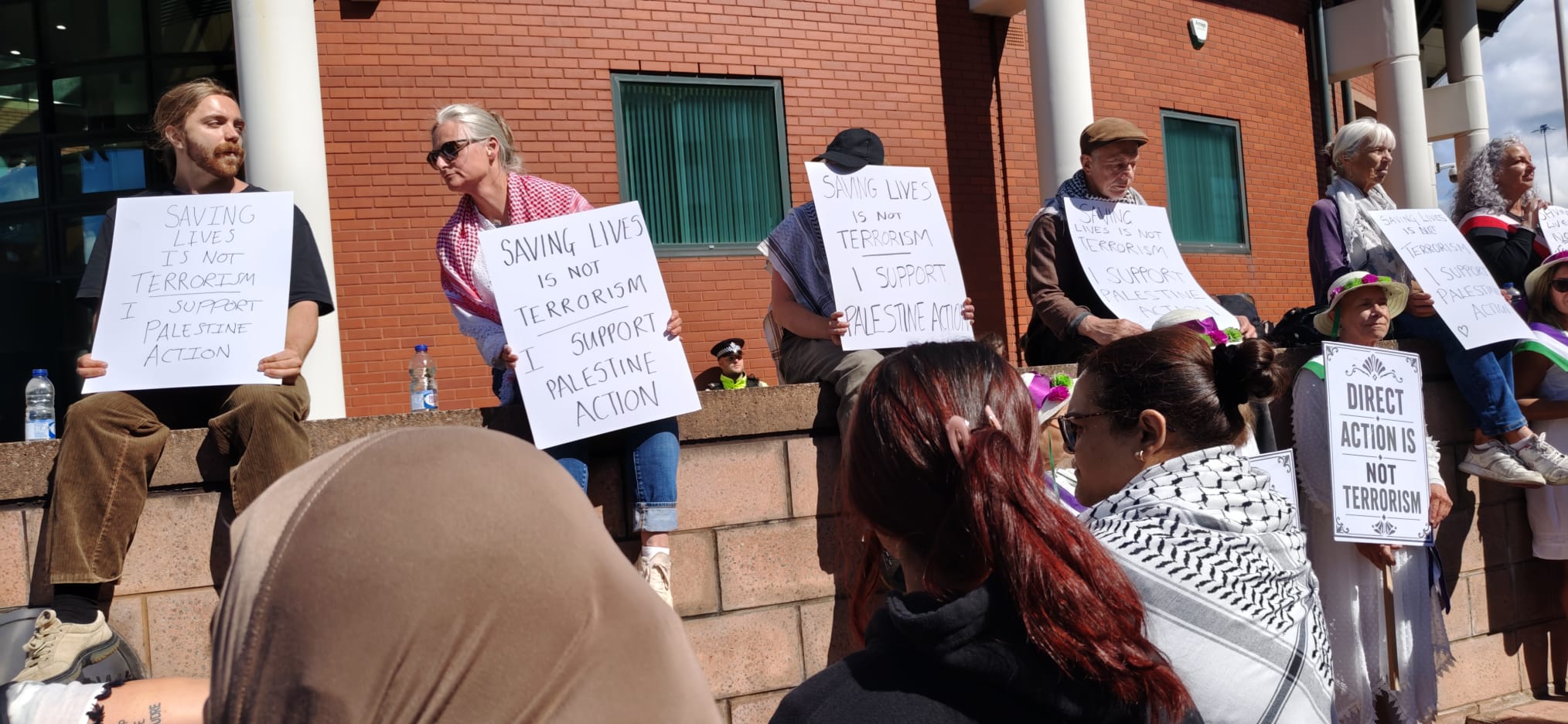
Outside Preston Crown Court, police moved in to arrest a number of activists holding placards allegedly expressing support for Palestine Action at a rally of supporters of the Barclays Five activists who were being sentenced inside.
Palestine Action was not proscribed at the time of the Burnley protest. Its subsequent proscription has itself been the subject of major legal challenges, with the Court of Appeal ruling in June 2026 that the Home Secretary’s decision to ban the organisation was “lawful.”
For campaigners, however, the Burnley case remains an important test of how far the authorities are prepared to go in treating human rights motivated direct action as terrorism.