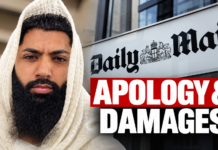



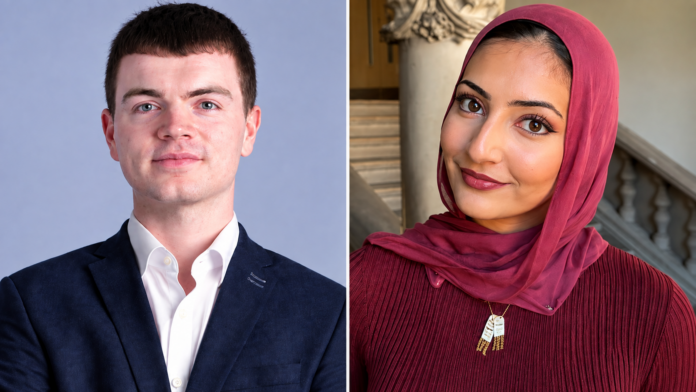
A Palestinian student has spoken out after Royal Holloway University made an undisclosed payment to a Zionist student who admitted referring to the keffiyeh she was wearing as a “tea towel.”
Huda El-Jamal, founder and president of Royal Holloway’s Friends of Palestine Society, has criticised the university’s handling of the case involving fellow student Brodie Mitchell, who describes himself as a “non-Jewish Zionist.”
The controversy stems from an encounter between the two students at Royal Holloway’s Freshers’ Fair on September 23, 2025.
While El-Jamal and Mitchell give sharply conflicting accounts of how the confrontation began, Mitchell acknowledges making the “tea towel” remark about her keffiyeh.
He subsequently accepted that the comment was “poorly expressed and inappropriate,” said he regretted making it and acknowledged that it could cause offence.

But after Mitchell challenged disciplinary action taken against him, Royal Holloway settled his legal claim and made him an undisclosed payment as a “gesture of goodwill.”
The university admitted no liability and maintained that the dispute concerned Mitchell’s conduct rather than freedom of speech.
Subscribe to our newsletter and stay updated on the latest news and updates from around the Muslim world!
El-Jamal has now spoken publicly about her experience and the subsequent controversy surrounding the case.
“All I did was follow procedure. I reported what happened to me. I trusted this institution with my dignity, and this institution failed me,” she said.
What happened at Freshers’ Fair?
In her account of the September 2025 incident, El-Jamal said she was a few metres away from the Friends of Palestine stall and talking to a friend while wearing her keffiyeh as a hair covering.
She said Mitchell approached her while recording on his phone, laughed and asked why she had a “tea towel” on her head. El-Jamal said the keffiyeh was a symbol of Palestinian “identity, resistance and belonging” and said she did not regard the remark as a joke.
She subsequently reported the encounter to Royal Holloway and to the police.
Mitchell gives a different account of what happened before his remark.
In evidence presented during his High Court case, Mitchell alleged that El-Jamal pointed towards him and said something along the lines of “here’s the wannabe Jew,” followed by a comment about him not wearing a kippah.
Mitchell said he began recording because he realised he had no witnesses and responded by referring to El-Jamal’s keffiyeh as a “tea towel.” He characterised his remark at the time as an off-the-cuff response to what he considered an attack upon him.
El-Jamal categorically denies calling Mitchell a “wannabe Jew” or making the remarks about a kippah. She says Mitchell’s account of the encounter is false and says she had a witness to what happened.
Mitchell suspended
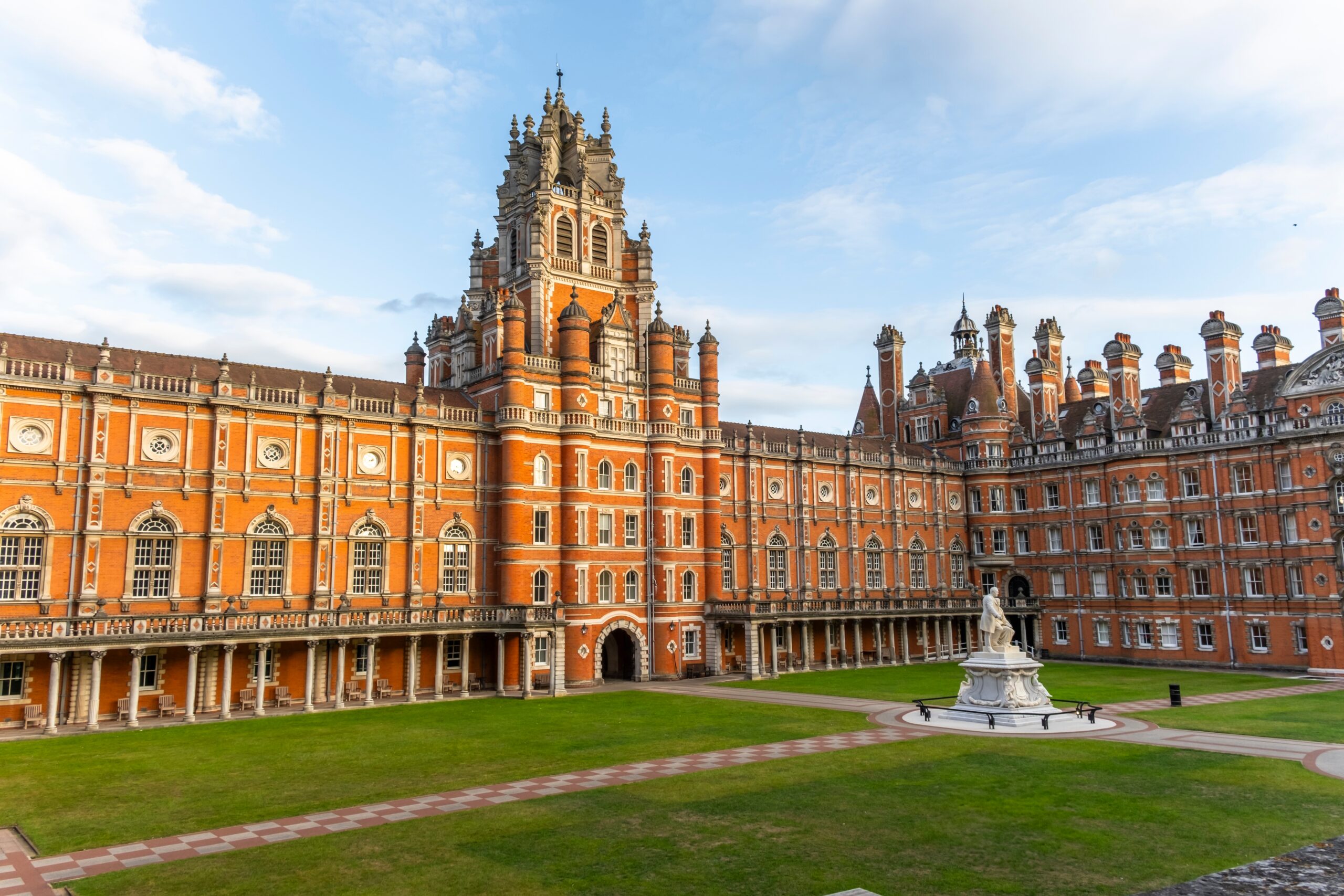
Royal Holloway suspended Mitchell the day after the encounter over alleged conduct that the university said could be considered hate speech, as well as the filming of individuals without their consent.
He later said the action resulted in him losing seven weeks of tuition, amounting to 68 teaching hours, and caused serious disruption to his studies. Mitchell subsequently took legal action against Royal Holloway with support from the Free Speech Union.
His case was that the suspension and disciplinary proceedings represented a disproportionate interference with his freedom of expression. Royal Holloway rejected that characterisation.
During the dispute, the university maintained that its student conduct procedures existed to address unacceptable behaviour and provide students with a safe and inclusive campus environment.
The case reached the High Court, where Mitchell unsuccessfully sought an interim mandatory injunction against the university in December. A substantive hearing was expected to follow, but the two sides eventually reached an out-of-court settlement.
Royal Holloway makes payment
Under the settlement, announced in April, Royal Holloway made an undisclosed payment to Mitchell. However, the agreement was reached “without any admission of liability” by the university.
Royal Holloway also explicitly rejected the suggestion that the underlying dispute was principally about free speech. Its position “has been, and remains, that this case concerns conduct and the appropriate application of its regulations, not freedom of speech,” the agreed statement said.
The university nevertheless acknowledged shortcomings in the way Mitchell’s suspension had been handled. It accepted that it “could have been clearer” in communicating the meaning and effect of his suspended deregistration and expressed regret about the length of time for which he was suspended and the distress this caused.
It was “in recognition of that” that Royal Holloway made an undisclosed payment to Mitchell as a “gesture of goodwill.” Mitchell agreed not to pursue his legal claim against the university.
Importantly, the settlement did not retract Mitchell’s acknowledgement concerning his original remark. The joint statement said: “Mr Mitchell accepts, as he has since he made it, that the comment which gave rise to the disciplinary proceedings was poorly expressed and inappropriate. He regrets making it and understands that it could cause offence.”
Huda El-Jamal speaks out
El-Jamal has strongly criticised the way the case developed after she made her original complaint.
In her video statement, she said she had initially remained silent while Mitchell’s version of events received coverage in national media.
She strongly rejected the allegation that she had called him a “wannabe Jew” and said she had been portrayed as antisemitic as a result of an allegation she denies.
El-Jamal said: “I reported what happened to me. I trusted this institution with my dignity, and this institution failed me.”
She has also questioned why Mitchell ultimately received a payment from Royal Holloway after she had followed university procedures by reporting the encounter.
Mitchell rejects El-Jamal’s characterisation of his conduct.
He has denied carrying out a racist attack and maintains that his remark was made in response to comments directed at him.
Mitchell has also argued more broadly that he and other openly pro-Israel students have faced hostility on campus because of their views.