


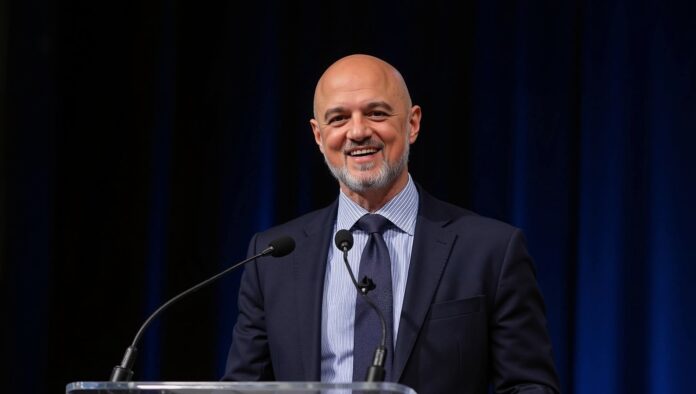
A UAE-funded mercenary allegedly carried out a covert surveillance operation against prominent British Muslim activist and academic Anas Altikriti on the streets of London, with evidence suggesting that discussions surrounding the operation may have included the possibility of killing him.
An investigation by ITV News has revealed that Abraham Golan, a former French Foreign Legion soldier and dual Hungarian-Israeli citizen, travelled to London in December 2016 while working for the United Arab Emirates and mounted an operation targeting Altikriti, the chief executive of the Cordoba Foundation.
The investigation, based on witness testimony, emails, text messages and confidential Emirati records, raises serious questions about the activities of UAE-funded operatives in Britain and whether a close British ally was involved in what ITV News described as a “potentially hostile operation” on UK soil.
Golan’s company, Spear Operations Group, had previously been paid millions of dollars by the UAE to assemble a covert team of Western military veterans for operations in Yemen.
According to ITV News, the team’s task was to hunt down and kill figures whom the Emiratis regarded as terrorists, including politicians accused of links to the Muslim Brotherhood.

Golan later admitted his involvement in the programme, previously telling BuzzFeed News: “There was a targeted assassination program in Yemen. I was running it. We did it. It was sanctioned by the UAE within the coalition.”
One of Golan’s former colleagues, Dale Comstock, also told ITV News that the operation in Yemen had been conducted on behalf of the UAE. “For all intents and purposes, we were Emirati soldiers,” he said.
Subscribe to our newsletter and stay updated on the latest news and updates from around the Muslim world!
‘They wanted me killed’
Following the release of the ITV story, Mr AlTikriti shared a more detailed public statement:
“Last night’s ITV News investigation exposed something I have long suspected but have never been able to prove; the UAE funded an operation to spy on me, track my movements, and threaten my life. No one should live in fear because of the political beliefs they hold. As a British Citizen living in Britain, it terrifies me that simply because I am critical of a foreign country, they are able to threaten my life and the safety of my family. Abraham Golan, a foreign mercenary employed by the UAE, came to the UK to meet with associates who were following me, taking pictures of my home, tracking my route into work, and attempted to meet with me in person under false pretences.
“These associates make it clear that the ultimate goal of this was to have me killed. My life has been dedicated to public service, facilitating dialogue, and fighting for humanity and peace. The UAE considering me to be a threat and targeting me on the streets of London is alarming for anyone who believes in our country’s sovereignty, regardless of personal politics. While our government considers the UAE to be an ally, they cannot allow that relationship to be unconditional.
“Our partnerships with foreign countries have to be based on trust, shared values, and accountability. It is about time that a thorough investigation is carried out by our government and key questions must be asked: What did they know about this plot? How long have they known? What response should I expect from the UK government to this revelation? Everyone should have the right to criticise and disagree without being threatened.”
The Muslim Association of Britain, a British-Muslim advocacy group which knows Mr Altikriti well, also expressed its shock and horror at the news.
“The MAB is horrified by ITV News’s revelation that a UAE-funded mercenary ran a covert surveillance operation against Dr Anas Altikriti, our former president, on British soil. Dr Altikriti’s home, office, and daily route to work were all logged and shared like target data. This is what happens when a foreign state believes it can act with impunity on British soil. This is the same regime that used Pegasus spyware on a device inside 10 Downing Street, the Prime Minister’s own office. The pattern is consistent: covert operations against British citizens and British institutions, run from Abu Dhabi, with no expectation of consequence.
“That cannot continue. We are calling for an urgent, independent investigation into the full extent of UAE interference in the UK, from covert surveillance to political funding. Britain cannot go on treating this relationship as business as usual. Our government must say, unequivocally, that no ally is above the law when it turns Britain into a hunting ground for its critics. British citizens deserve to know their government will protect them from a foreign regime, not make excuses for it.”
Targeted in London
Confidential records seen by ITV News reportedly show that Golan was being paid by the UAE throughout his London operation, which involved a month of planning and at least several days on the ground.
During the operation, he worked alongside a former U.S. Navy SEAL and discussed ways to locate, track and potentially kill Altikriti, a prominent British Muslim campaigner whom Abu Dhabi had come to regard as a threat.
The British activist was only recently informed by the broadcaster that he had been the subject of the operation a decade earlier.
“I feel physically sick,” Altikriti said after being shown messages, photographs and other material connected to the operation. The documents reportedly included photographs of his home and his distinctive black hatchback, with one image labelled: “Target’s house and car.”
“At the time my children were three and one and a half years old,” Altikriti said.
Golan also allegedly shared maps and reconnaissance notes identifying Altikriti’s likely routes between his home and work, including the entrance he was expected to use at his office block.
When asked who he believed had been behind the scheme, Altikriti replied without hesitation: “Oh, the UAE.”
The revelations come against the backdrop of the UAE’s long-running hostility towards the Muslim Brotherhood and organisations or individuals it alleges are connected to the movement.
In November 2014, the UAE published a list of 83 organisations it had proscribed under its laws against violent extremism. Alongside groups such as ISIS and Al Qaeda, the list included three British organisations: Islamic Relief, The Muslim Association of Britain and the Cordoba Foundation – which Mr Altikriti is associated with.
The organisations rejected the classifications, and ITV News reported that British officials at the time sought an explanation and evidence from the UAE for its decision, non of which was provided. The Cordoba Foundation has consistently denied any formal association with the Muslim Brotherhood.
Altikriti told ITV News: “I have good relations, because my father is my father. I understand the ideology, I studied the ideology of the Muslim Brotherhood, I believe the Muslim Brotherhood to be a valid ideology for people who are seeking to free themselves from the clutches of oppression. However, I’m a Brit, I grew up in Britain. In my life I have never done anything wrong whatsoever.”
Altikriti was later contacted by police in London and warned to be vigilant because of threats to his safety. Officers visited his home twice but, according to Altikriti, were unable to disclose the details of the threat.
UAE’s Muslim Brotherhood obsession
The UAE’s bitter hostility towards the Muslim Brotherhood has roots stretching back decades. Brotherhood members fleeing repression in Egypt and elsewhere arrived in the Gulf during the 1950s and 60s and initially gained influence in areas such as education and religious life.
In the UAE, the group Al-Islah, established in 1974, became the organisation most closely associated with Brotherhood-inspired activism. However, relations with the authorities deteriorated over time, as Abu Dhabi became increasingly suspicious of the Brotherhood’s transnational political ideology and its influence within Emirati society.
 Tensions intensified dramatically following the Arab Spring of 2011, when uprisings swept across the Middle East and Brotherhood-affiliated movements emerged as major political forces, most notably in Egypt. The UAE leadership viewed the rise of political Islam as a potential threat to the region’s hereditary monarchies and launched a major crackdown on Al-Islah and other activists.
In 2014, the UAE formally designated the Muslim Brotherhood and Al-Islah as terrorist organisations, placing them on the same list as groups including Al Qaeda and ISIS. The Emirati government has consistently maintained that the Brotherhood represents an extremist threat to national and regional security, while the Brotherhood and its supporters reject this characterisation and accuse Abu Dhabi of using counter-terrorism measures to suppress political and religious opposition.
In current times, the UAE’s obsession with perusing and opposing the Brotherhood globally has reached social media with a new generation of so-called Emirati influencers pushing scripted propaganda which targets English-language audiences.
The content obsessively demonises and fear mongers against the Brotherhood and alludes to a conspiracy of global conquest by the group in a manner intended to create significant anxiety in countries which the UAE hopes may eventually start to legislate against Muslim activists and groups which Abu Dhabi doesn’t like.
For Altikriti, the discovery that his home, movements and family life were allegedly monitored by operatives linked to a foreign state has provided a disturbing explanation for police warnings he received years ago – and renewed concerns about the lengths to which the UAE may be prepared to go against those it considers ideological opponents.