


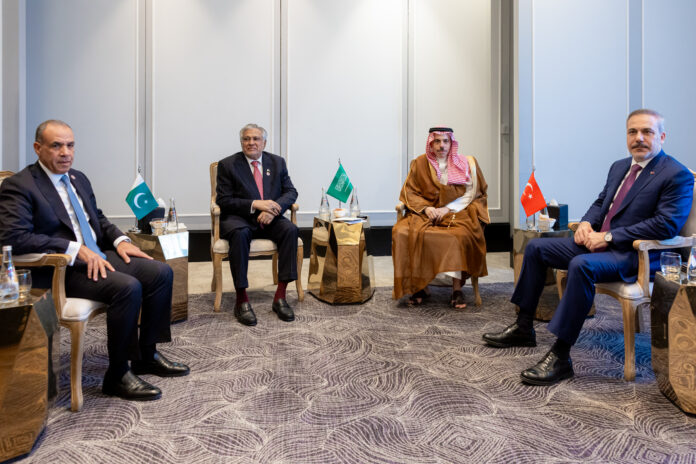
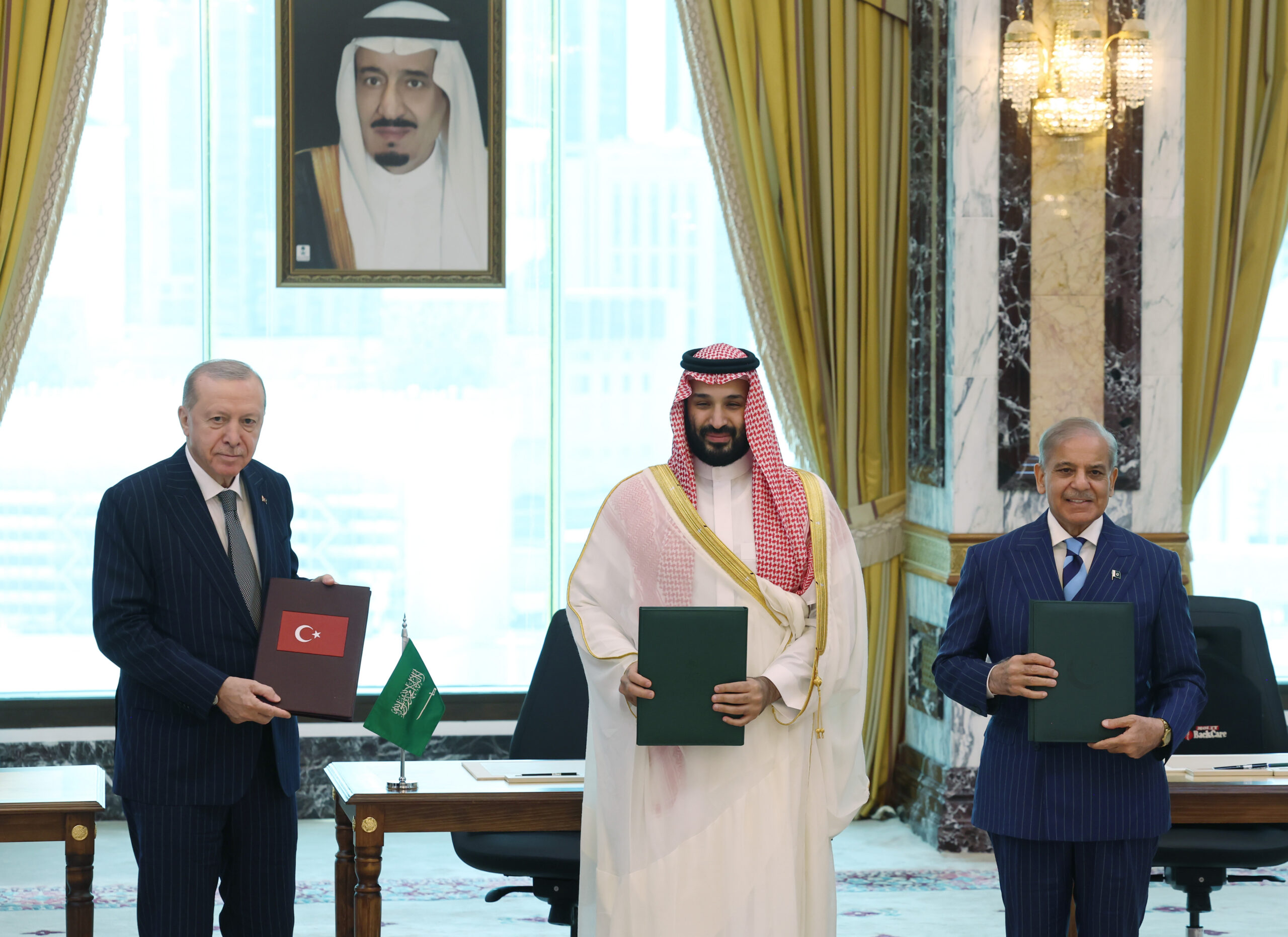
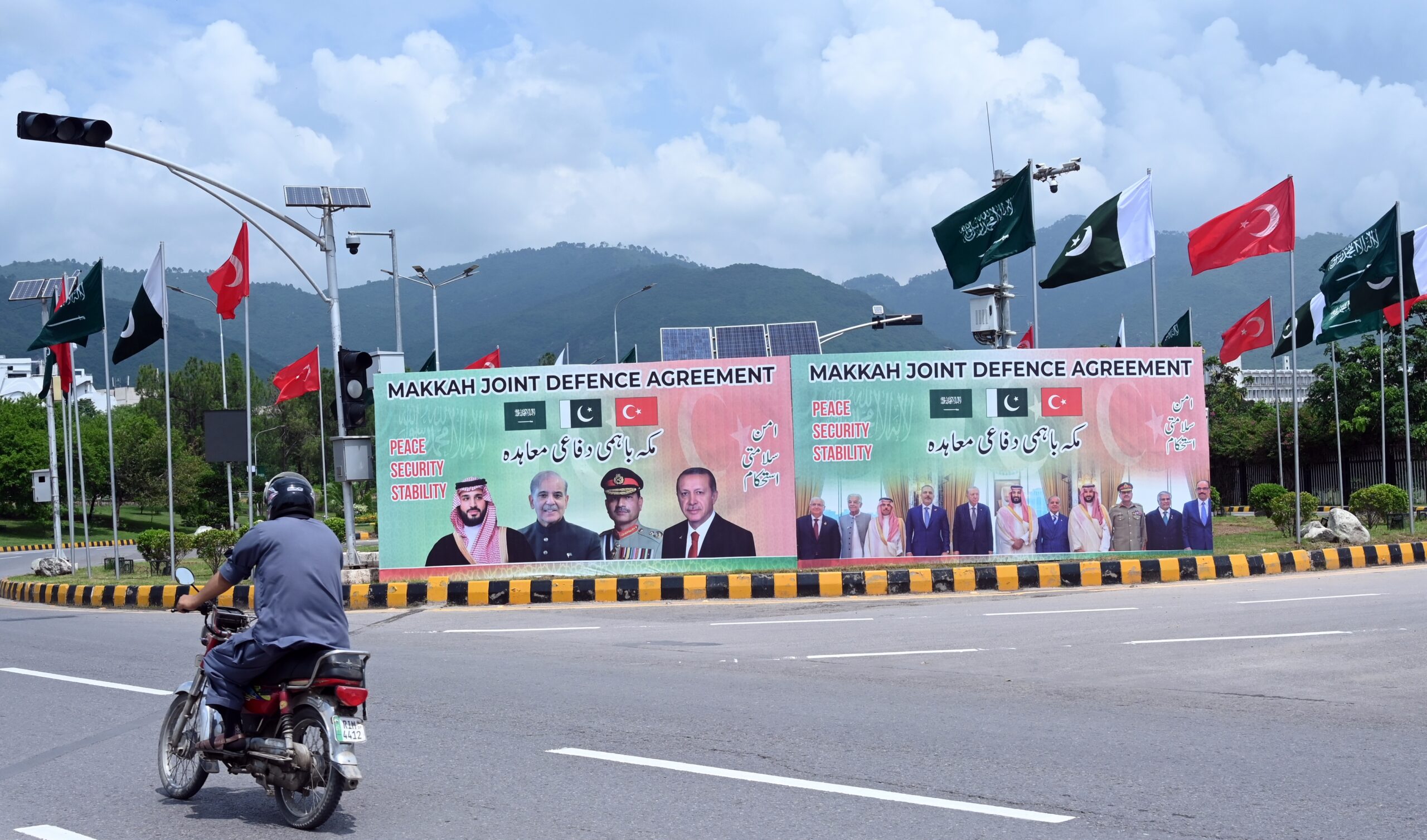
The historic Mecca defence agreement between Saudi Arabia, Turkiye and Pakistan is a key step toward lasting stability in the region which has long been marked by instability since the loss of the Ottoman Caliphate says Turkish Foreign Minister Fidan.
Speaking at Anadolu’s Editor’s Desk program, Fidan said the agreement signed by the three Muslim powers aims to contribute to lasting stability in the region.
“There is no common threat that we have put in writing,” Fidan said, adding that the agreement does not target any country that does not attack its signatories.
Fidan said discussions on the initiative began before the current war environment, when there was no Iran-US-Israel war, but Türkiye anticipated that American security concerns in the region would change, other developments would emerge and its fight against terrorism would remain high on the agenda.
He stressed that Türkiye, Saudi and Pakistan are not expansionist countries.

“Saudi Arabia, Pakistan and Türkiye, when you look at their foreign policy positions, are not countries that have expansionist policies. They are countries concerned with their own borders, their own problems and their development, and, if possible, they want to contribute positively to their environment through good relations and good neighbourliness,” he said.
Fidan said the three countries have different styles and capacities, but when brought together, they naturally form a defence-oriented organisation rather than an offensive one.
Subscribe to our newsletter and stay updated on the latest news and updates from around the Muslim world!
“Now, when we come together with these countries, naturally we are becoming a defence-oriented organisation. It is not an approach of going on the offensive and saying, ‘Let’s do this or that together.’ Therefore, unless it is attacked by a country, whether from inside or outside the region, this alliance cannot have any dispute with any country. But, of course, the power composition we have put forward will make a constructive contribution to regional stability,” he said.
Fidan said that was the reason for advancing the initiative and stressed that Iran was not the target of the agreement. He added that countries that do not attack the signatories are not considered targets.
Fidan said the alliance had been examined closely from legal, political and strategic perspectives and that Türkiye saw no problem with the framework. He also noted that NATO countries had previously concluded similar agreements.
“Under our president’s vision, we should not remain limited to three countries. We should grow and, if necessary, bring all countries under this umbrella,” he said.
“The Mecca Agreement is the most important step toward bringing lasting stability to this region,” Fidan said, adding that the region has experienced instability in the past century since the withdrawal of the Ottoman Empire.
Fidan described the signing of the agreement as a “historic day”, saying it represented one of the milestones that Türkiye had been pursuing for years under President Recep Tayyip Erdogan’s leadership.
NATO comapriosn
Pointing out that the agreement imposes obligations on the signatory countries, Fidan noted that Türkiye has been a member of NATO since 1952, and has participated in NATO meetings for many years.
Fidan said the Mecca Joint Defence Agreement is technically similar to NATO’s Article 5 on collective defence, allowing members to benefit from each other’s protective support.
He said NATO’s core deterrence is defensive, built around the message: “If you attack me, I have the military power of this large alliance.” He said this prevents conflict and enables countries to resolve political and economic problems.
NATO has only taken collective military action in a limited number of cases, including Afghanistan and Kosovo, he added.
He emphasised that the alliance’s core purpose is to ensure that potential adversaries understand the consequences of attacking a member, thereby creating an environment in which countries can address their political and economic problems and pursue development without being disrupted by conflict.
Fidan stressed that violence, war and bloodshed are among the main factors preventing regional development.
“We are now in solidarity with each other,” Fidan said, explaining the principle behind the alliance.
“You increase your deterrence capability. Secondly, rather than sending a message to an outside party, countries signing such alliances demonstrate and commit that they will not pose a threat to each other’s security, but instead guarantee each other’s security,” he said.
Fidan said this was the starting point of a security alliance, adding that the members would subsequently need to work according to existing threats.
Asked whether an attack would immediately trigger an obligation under the agreement and how such an obligation would become operational, Fidan said the text contains general commitments whose practical implementation would depend on discussions and decisions by relevant bodies.
He said a country would need to make a request for assistance and would determine the type of support it needs.
Fidan added that a country could request different forms of support, ranging from intelligence and logistics to ammunition or, if necessary, military units, depending on the scale of the threat.
He said the alliance would have a political and military committee comprising foreign and defence ministers and chiefs of general staff, similar to NATO structures.
The committee would translate the vision set by the leaders into decisions within the alliance and carry out related work, while a secretariat would be established to implement those decisions, he added.
Saudi-Iran tensions
Fidan said Saudi Arabia had invited the chiefs of general staff of 40 countries to a meeting on Red Sea security.
He said Saudi Arabia framed the issue in terms of global trade security and the security of the Bab el-Mandeb Strait rather than asking countries to help with its bilateral problem with the Houthis.
“The Saudis actually brought the issue up in terms of global trade security and the security of Bab el-Mandeb. They did not turn it into a situation of saying, ‘Come and help me with my bilateral problem with the Houthis,'” he said.
Fidan said Türkiye’s participation was also directly linked to its commercial interests.
He said the closure of the Red Sea trade route would directly affect Türkiye’s interests, while the closure of the Strait of Hormuz would not have a similarly direct effect on Türkiye’s energy supplies because Ankara had secured its energy routes through pipelines over many years.
He said Türkiye’s military interest in Red Sea security was therefore natural, while the international community was discussing measures for the area. Erdogan had given the approvals, and the chief of general staff was participating in the meetings.
Yemen’s Houthi group are a close ally of Iran and have posed a serious national security threat to Saudi on its southern border. Saudi oil interests have also been targeted by the group including key Aramco infrastructure. Any significant involvement by Turkiye or Pakistan in aiding Saudi’s war on the Houthis in Yemen could lead to a strain in Ankara and Islamabad’s currently amicable relationship with Tehran.

Fidan said Saudi Arabia did not have a strategy aimed at attacking or eliminating Iran.
He said Riyadh did not want to fight Iran or eliminate it and instead wanted the violence around the Strait of Hormuz to end as soon as possible, and conveyed to the US that military intervention against Iran was not a solution.
Fidan said Saudi Crown Prince Mohammed bin Salman reiterated that position during their recent meeting in Mecca and that the same position had been conveyed in discussions with US President Donald Trump.
He said Saudi Arabia favoured resolving the issue through dialogue and an agreement, rather than military intervention.
He stressed that alliances alone could not prevent countries from suffering the consequences of regional wars.
“You have to be deterrent enough not to be attacked. But problems need to be managed in different ways,” Fidan said.
Fidan said the Saudi-Iran issue was not simply a matter of the two countries having a dispute, adding that the involvement of the US and Israel had also contributed to the emergence of the problem.
He said Türkiye had discussed the issue with Iranian officials for more than two years and maintained that Iran could play a constructive role in regional cooperation once it addressed its own problems.
“Two years ago — we have been discussing this in the region. There were also periods when we discussed these issues with the Iranians. When Iran solves its own problems in the region, when it needs to contribute to the region’s constructive policies and enter that collective sphere, their role is also needed. We always tell them this; the Iranians are not unfamiliar with this issue,” Fidan said.
Fidan also said the alliance would draw lessons from existing models, particularly NATO, describing it as the most significant enduring large-scale defence organisation outside of which few comparable examples exist.
He said NATO offered a major body of experience from which the new alliance could learn, particularly in terms of best practices.
Fidan said the most important priority in the US-Iran crisis was reaching an agreement that would allow the Strait of Hormuz to reopen.
He noted that an understanding reached between Iran and the US on June 14 through Pakistani mediation initially provided for the release of Iranian frozen assets by the US in exchange for the reopening of the strait and Iran refraining from charging fees for passage through the strategic waterway for 60 days.
Fidan said proposals on the issue had matured and reached a certain point, adding that an outcome could be achieved once the procedural arrangements between Oman and Iran were fully agreed.
He said decision-making processes in Iran could sometimes take longer because of circumstances surrounding its leadership, security threats and accessibility.
He said regional countries, the US, Europe and Asian countries all wanted the strait reopened as soon as possible.
“We are talking to the parties as Türkiye. If there is a point in the process where we think it is blocked, we try to open it,” he said.
He said the parties were also discussing how passage through the strait would be regulated and that countries bordering the strait could potentially make additional contributions.
Israel’s greatest fear
Fidan said the most important issue for moving to the second phase of the Gaza Peace Plan was Hamas laying down its weapons under certain conditions.
He said Israel had hesitated to begin that process and argued that Israel had never believed Hamas and the Palestinians were capable of solving certain issues diplomatically.
Fidan said Israel had repeatedly postponed the next stage whenever an issue appeared to have been resolved.
He noted that Israel carried out an attack approximately four to five hours after Hamas accepted the proposal, resulting in the deaths of 18 people.
Fidan said it was something Israel had repeatedly done and argued that even strongly pro-Israel Zionist circles increasingly could not find a sentence with which to defend Israel in such circumstances.
He said Palestinians would reward an approach by Hamas that placed the existence of the Palestinian people ahead of the organisation’s own existence.
Fidan said Israel would continue pursuing those tactics as long as its fundamental objective remained depopulating Gaza of Palestinians, and stressed that political mobilisation to prevent this must continue without interruption.
Fidan said Israel’s greatest fear was international isolation.
“Until today, with the very broad capabilities it has — capabilities located in other countries — it has used them to create an illusion in the world. There is a political practice built on this illusion that continuously works in Israel’s favour, regardless of the circumstances,” Fidan said.
He said the world was increasingly seeing the “diabolical difference” between the constructed illusion and reality with its own conscience.
Fidan said it was not simply an ordinary misconception or a matter of correcting an error, but a broader struggle in which people’s perceptions had been shaped through a multi-layered, systematic information and illusion campaign.
He said politically aware people living in the region had long understood that, but it was now becoming a major realisation for the rest of the world.
Fidan said that as awareness increased, Israel would face greater isolation.
He warned that new stories, provocations and narratives could be created and said governments needed to be prepared.
Islamic support for the new alliance
Fidan said the Mecca Joint Defense Agreement had received strong support from countries in the Islamic world, including those that were not members but were nevertheless very pleased with the agreement.
He said there were also supporters in the West who understood the substance of the initiative.
“Especially in the Islamic world, there are many who strongly support this issue. There are also supporters in the West, among those who understand the essence of the matter. The way for the Middle East to cease being a place that produces problems for humanity and the international community and instead become a place that creates added value with everything it possesses is through implementing constructive alliances of this kind,” Fidan said.
Fidan said the leadership of Türkiye, Saudi Arabia and Pakistan had created significant regional and global expectations and that officials now had the responsibility to fill those expectations professionally.
“Our responsibility, in the positions we hold, is to recognise that the political will put forward by the leadership of the three countries has created a very significant regional and global expectation. We need to fill that expectation very professionally, move forward step by step and make it work. We have begun doing this, and God willing, we will continue,” he said.