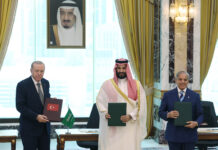




U.S. President Donald Trump has approved a landmark nuclear agreement with Saudi Arabia which could last 30 years and is estimated to be worth tens of billions of dollars.
The nuclear deal, reportedly approved by President Trump, will provide Saudi Arabia with a civilian nuclear programme, The Wall Street Journal reported on Tuesday.
According to U.S. officials, the deal is estimated to be worth tens of billions of dollars.
The report revealed that one of the primary purposes behind the deal is to give American companies a key role in developing and contributing to Saudi Arabia’s nuclear infrastructure, which would in turn shut out foreign competitors.
A key aspect of the deal includes involving American companies in building a uranium enrichment plant in Saudi Arabia, should Washington and Riyadh consider the move justified.

The report also claimed that the deal would give the U.S. the opportunity to further monitor Saudi Arabia’s nuclear ambitions, which Trump administration officials said would help prevent the misuse of the programme in developing weapons.
Despite the deal being approved, the actual agreement will have to be sent to Congress for review in the coming days, where it is likely to face pushback and opposition from lawmakers concerned about the expansion of nuclear capabilities in the Middle East.
Subscribe to our newsletter and stay updated on the latest news and updates from around the Muslim world!
Nuclear umbrella
During Saudi Crown Prince Mohammed bin Salman’s visit to the White House in November last year, the Saudi push to be included under the U.S. nuclear umbrella was raised as a key issue.

Saudi Arabia has already signed a defence pact with Pakistan, which is currently the only nuclear-armed state in the Muslim world.
Coming under the U.S. nuclear umbrella would likely shift the previous dynamic and agreements the Saudis had made in the Muslim world.
A former U.S. intelligence official said that “it would pull them out of Pakistan’s nuclear umbrella and make the Saudis feel better than the Qataris.”
Saudi Arabia has previously expressed that it would need a nuclear weapons programme if Iran acquired one. Lengthy talks have also revealed that the U.S. feared that Riyadh would look elsewhere for nuclear technology if the U.S. did not provide what they wanted.
In a report to Congress earlier this year, the U.S. administration expressed support for the U.S.-Saudi nuclear deal to “prevent strategic competition from seizing an opportunity to undermine United States national security interests for decades to come.”
The report also argued that the U.S. must capitalise on the opportunity to expand nuclear cooperation in order to “reestablish our leadership in the global civilian nuclear energy market and reap the benefits of expanded influence in foreign countries hosting our reactors.”