




The first national study on UK Muslim converts since 2001 has been launched to shed light on Britain’s Muslim convert population, amid estimates that more than 150,000 people have embraced Islam without official data tracking them.
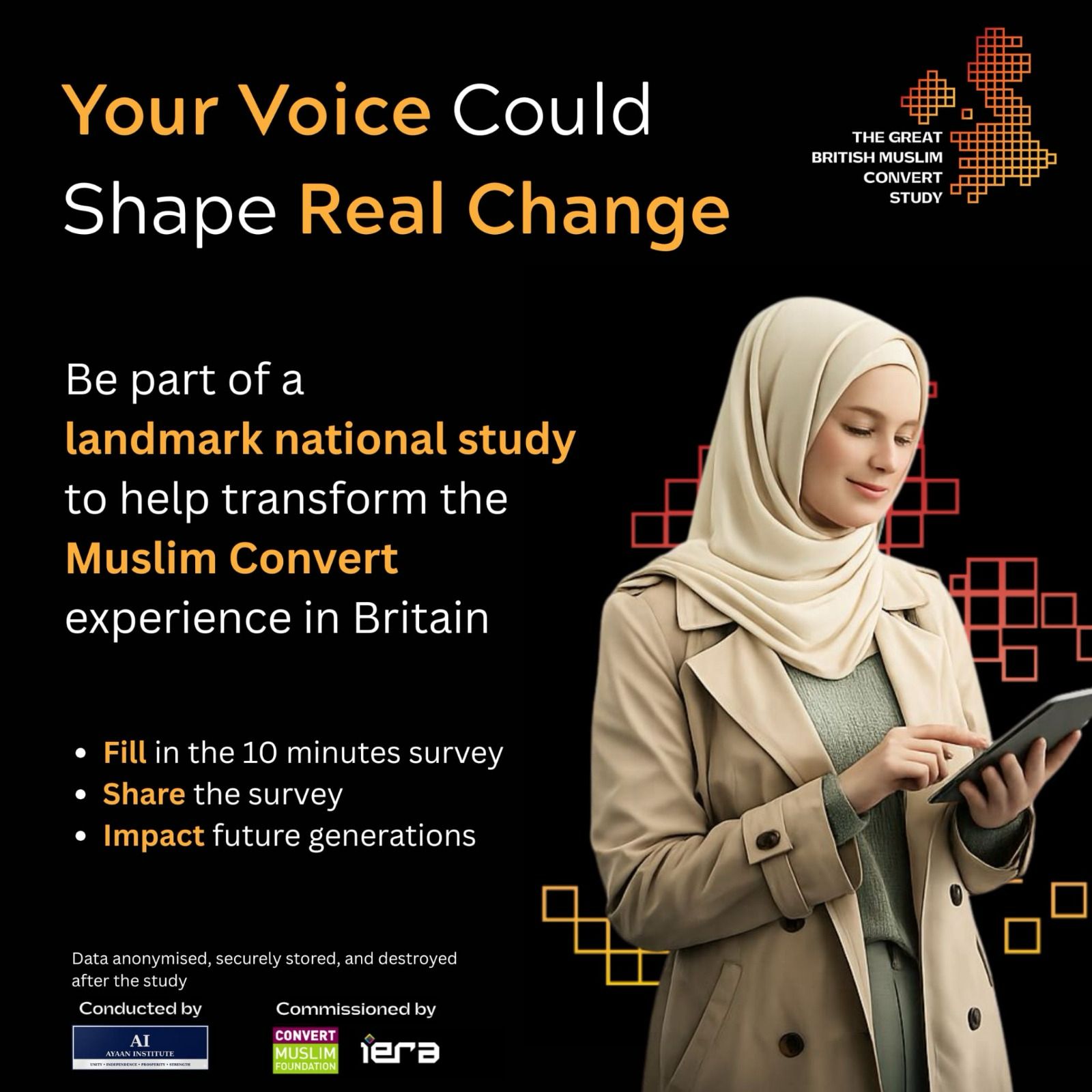
The Islamic Education and Research Academy (iERA) and Convert Muslim Foundation (CMF) have commissioned a nationwide study, led by the Ayaan Institute, to better understand conversion to Islam in Britain.
With no official data on the 150,000+ estimated Muslim converts, the Ayaan Institute landmark investigation seeks to uncover why Britons are converting to Islam – and why so many later disappear from community life.
A major national study launched today promises to solve one of Britain’s most underreported religious shifts: the rapid, quiet growth of the country’s Muslim convert population.
While government data tracks ethnicity and traditional faiths, there is currently no reliable national dataset on people who embrace Islam. Estimates vary from 30,000 to over 150,000.

The new Great British Muslim Convert Study aims to replace guesswork with hard evidence for the first time.
Researchers will shine a light on four critical questions rarely explored:
Subscribe to our newsletter and stay updated on the latest news and updates from around the Muslim world!
- Who converts? Beyond the stereotypes of “prison or university”.
- Why now? The specific social or spiritual tipping points.
- Where do they go? Including the sensitive issue of why converts often disengage from mosques or leave the faith entirely.
- How many? Academically robust estimates of the total number of converts and conversions per year.
Unlike previous studies focused on security or radicalisation, this research prioritises the human reality behind the statistics.
“We know more about convert reoffending rates in the prison system than we do about convert success in family life,” said Yahya Birt, Research Director at the Ayaan Institute. “The public narrative is stuck on fear or fascination.
“We want to move to evidence. Why do some converts thrive, while others experience isolation, homelessness, or complete disengagement from religious support networks?”
Co-researcher Sociologist, Dr Will Barylo added, “This is not a security study. It is a social study about identity, belonging, and institutional failure. If a convert walks away from the Muslim community, we want to know why – not to judge them, but to fix what is broken.”
The team is inviting mosques, charities, and support groups working with converts to contribute anonymised data. Unlike academic studies that rely on small samples, this will use a collaborative, “whole-of-community” census approach.
All data will be anonymised and destroyed upon completion. Participating organisations will receive the first private briefing of the findings.
With the recent rise in public debates over religious identity, integration, and social cohesion, the lack of basic data on converts has become a glaring blind spot for policymakers, social services and faith leaders.
“The convert journey doesn’t end at the Shahada [declaration of faith],” said a spokesperson for the Convert Muslim Foundation. “It begins there. We currently have no national map of where that journey leads.”
The link to complete survey can be found here.