



Professor Khalid El-Awaisi of Ankara University explains how extremist Christian Zionist theology and settler-colonial Jewish nationalism are plotting to destroy Al Aqsa Mosque.
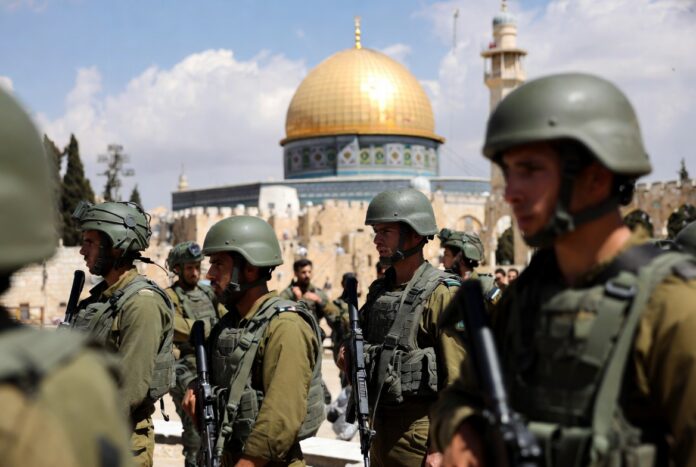
For more than a month, Muslim worshippers have been prevented from entering Al-Aqsa Mosque, a development that places one of Islam’s holiest sites at increasing risk.
At the centre of this crisis lies the intersection of Jewish and Christian Zionist ideologies, where political ambition and religious fervour converge in ways that could reshape the future of Islam in the Holy Land as fears rise of a conspiracy to ultimately destroy the Al-Aqsa compound.
Within Jewish tradition, the rebuilding of the temple and the final gathering of Jews in Palestine are tied to the arrival of the Messiah (Mashiach), who is expected to reunite the dispersed people and construct the “Third Temple”.
Historically, many religious Jews have opposed the modern secular Zionist interpretation of this belief, insisting that such events must occur through divine will and not before the messianic age.

However, the establishment of the modern nation-state of Israel through secular Zionism has given rise to a more radical current of thought, one that argues redemption must be actively pursued by human effort.
What was once regarded as a fringe perspective has increasingly entered mainstream Israeli politics, gaining influence at the highest levels. Within this trajectory, the occupation is seen as laying the groundwork for the eventual and the increasingly inevitable demolition of Al-Aqsa and the construction of their “Third Temple” as a defining symbol of Israeli identity.
Subscribe to our newsletter and stay updated on the latest news and updates from around the Muslim world!
Alliance with Christian Zionism
Christian Zionism, particularly among evangelical fundamentalists from the United States, promotes a literal interpretation of the Bible. It envisions the return of Jews to Palestine, the establishment of a Jewish state with Jerusalem as its capital, and the building of a temple on the site of Al-Aqsa Mosque as necessary steps preceding the return of Christ.
This theology, which predates Jewish Zionism and emerged in Protestant Europe, is rooted in the prophecy of Armageddon, a final, catastrophic battle between forces portrayed as good (Israel and Christian Zionists) and evil (in modern understanding, Muslims).
According to this narrative, the conflict would lead to the destruction of non-believers and, in some interpretations, even two-thirds of Jews. The doctrine has gained significant traction, particularly in the US, where it underpins consistent political support for Israel-aligned foreign policy and lobbying efforts.
The notion of a Jewish buffer state in Palestine originated among Christian Zionists before being adopted by Jewish Zionism. From 19th-century Britain to contemporary US policy, Christian Zionism has provided ideological justification and Western backing, facilitating the fulfilment of its prophetic outlook.

Recent developments, such as US recognition of Jerusalem as Israel’s capital and the 2020 “Deal of the Century”, demonstrate the continued alignment.
Over the past two decades, religious Jewish Zionists have deepened their alliance with Christian Zionists, using this partnership to advance the Judaisation of Al-Aqsa and Jerusalem. What began as sporadic incursions has developed into more structured forms of ritualised worship, alongside temporal and spatial divisions targeting the mosque.
Today, Al-Aqsa is either completely closed or reopened under Israeli conditions, a shift seen as a step towards the envisioned “Third Temple”. One example of this collaboration is the “red heifer” initiative.
The “red heifer” initiative is a project driven by Jewish and Christian groups aimed at identifying and raising a perfect, unblemished reddish-brown cow as described in the Book of Numbers 19. The ultimate goal is to sacrifice this animal, burn it to ashes, and use the resulting ashes mixed with water for ritual purification, a necessary step for building the Third Temple on the Temple Mount in Jerusalem, according to religious tradition and prophecy.
Despite traditional rabbinical prohibitions related to ritual impurity, American evangelical groups have supported efforts to genetically produce red heifers, thereby advancing preparations for temple construction and an eagerness to invade the site.
It is important to note that this alliance is not based on mutual theological alignment. Historically, Christian Zionism has viewed Jews as instruments within a wider apocalyptic narrative rather than equal partners.
Nevertheless, Jewish Zionism has increasingly relied on this support to further their political aims, while Christian Zionists regard the partnership as a means of accelerating end-times prophecy. The result is a convergence driven by overlapping political and religious objectives.
Fundamental differences
For Jewish Zionists, the temple represents the fulfilment of a divine covenant with the “chosen people” and the ultimate expression of national destiny. For Christian Zionists, however, it serves primarily as a stage in an apocalyptic sequence that ultimately leads to widespread destruction affecting both Jews and Muslims.
In this framework, Jews are positioned as actors within a broader eschatological narrative, one that culminates in catastrophic outcomes. While Jewish Zionists are aware of these theological implications, the symbolic and political significance of the temple continues to hold central importance in their vision.
Although both movements draw upon scripture to support their positions, their ultimate goals differ significantly, underscoring a partnership shaped more by expediency than shared belief.
What was once a distant theological concept has increasingly taken on concrete political form. The idea of demolishing Al-Aqsa has moved beyond speculative belief into the realm of international policy.
Western powers, most notably the United States, have adopted positions that echo elements of Christian Zionist thought, offering diplomatic and military support that reinforces Israel’s control over Jerusalem and Palestine.
This merging of religious ideology and political strategy carries far-reaching global consequences. Jerusalem is no longer solely a local or regional issue, but a focal point of wider geopolitical tensions where religious conviction intersects with colonial dynamics.
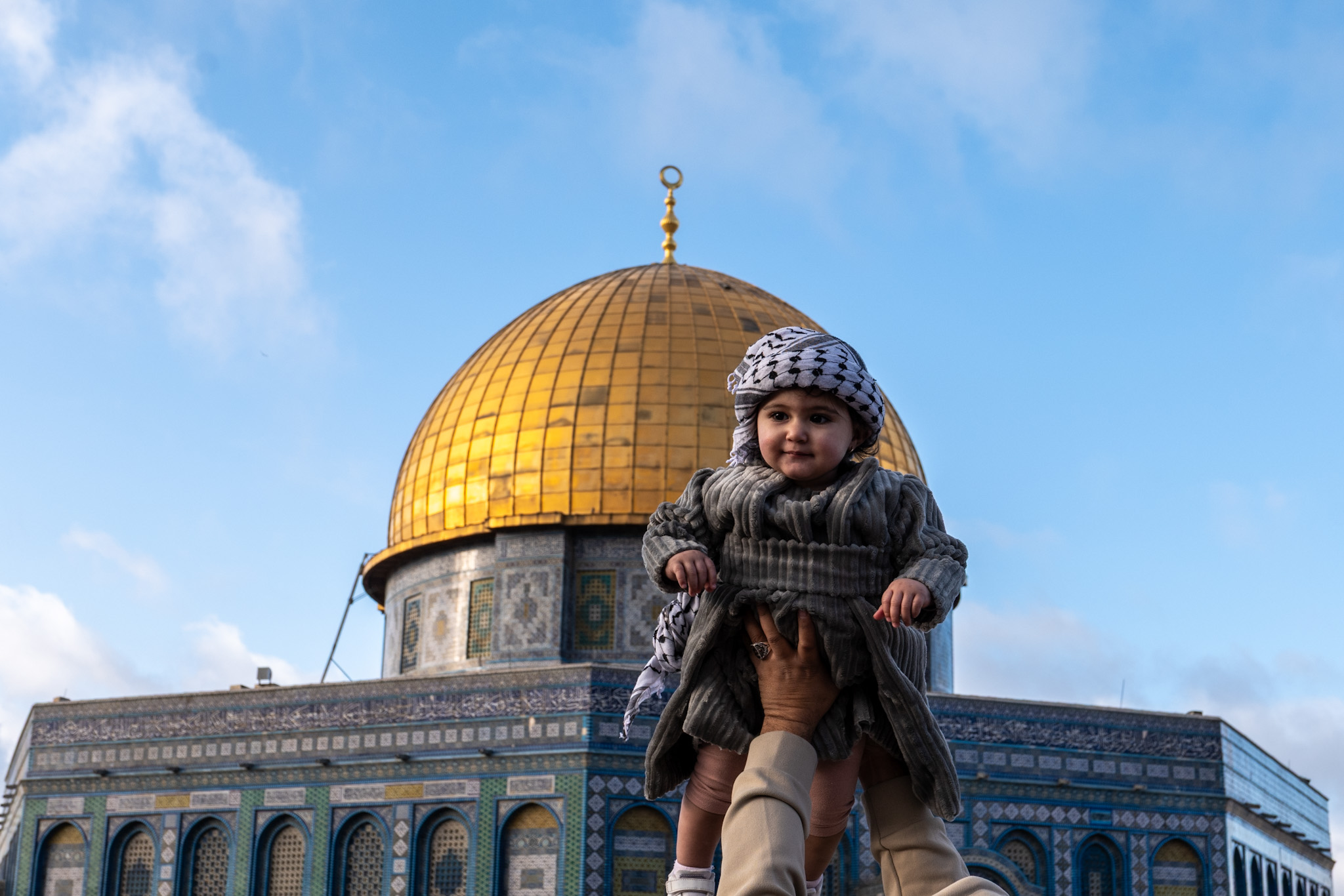
At the heart of this situation stands Al-Aqsa Mosque, not only as an Islamic religious site, but as a powerful symbol of Palestinian identity, sovereignty, and the future of the region – including religious co-existence.
The doctrine surrounding the demolition of Al-Aqsa reflects a particularly potent fusion of politicised religion: the intersection of extremist Christian Zionist theology with settler-colonial Jewish nationalism.
What began as theological speculation has evolved into a coordinated political project supported by state power and international alliances.
Within this context, the use of the name “Operation Al-Aqsa Flood” by Palestinians is framed not merely as rhetoric, but as an expression of an existential struggle. The defence of Al-Aqsa is portrayed as a defence of faith, dignity, and justice.
Safeguarding the site is therefore seen not only as preserving a religious landmark and communal identity, but also as a means of preventing the escalation of religious extremism into a broader global crisis.