


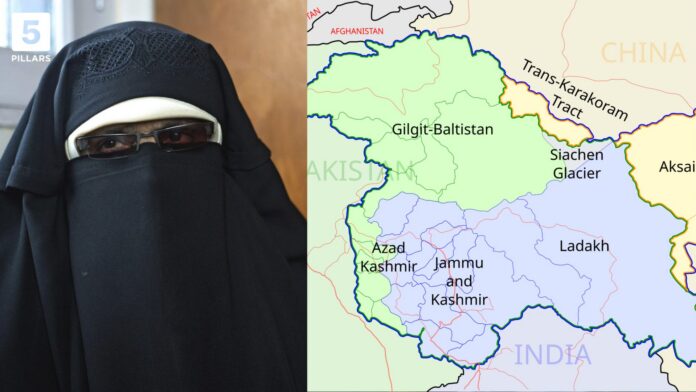
An Indian court has sentenced prominent Kashmiri Muslim leader Asiya Andrabi to life imprisonment, a move that has drawn criticism from rights groups and legal observers.
Andrabi, head of the women-led organisation Dukhtaran-e-Millat (Daughters of the Nation), was convicted earlier this year alongside her associates Sofi Fehmeeda and Nahida Nasreen.
While Andrabi was handed a life sentence, her co-accused were sentenced to 30 years in prison.
The verdict was delivered by a special court in Delhi under the widely criticised Unlawful Activities Prevention Act (UAPA), India’s primary anti-terror law.
Rights groups have long raised concerns over the legislation, saying it allows authorities to detain individuals for extended periods without trial and is prone to misuse.

Prosecutors alleged that Andrabi and her co-accused were involved in a “conspiracy to commit terrorist acts” and in “waging war against the state”, charges that carry severe penalties under Indian law, including life imprisonment.
The court said the punishment reflected the seriousness of the accusations.
Subscribe to our newsletter and stay updated on the latest news and updates from around the Muslim world!
However, Andrabi has long been regarded by her supporters as a political and religious activist advocating for Kashmir’s right to self-determination, the principle that people of the region should decide their own political future.
Origins
Her organisation, Dukhtaran-e-Millat, founded in 1987, focused on promoting Islamic values and opposing Indian rule in Kashmir before it was banned by the Indian government.
She was arrested in April 2018 by India’s National Investigation Agency (NIA), which handles terrorism-related cases.
Andrabi remained in custody throughout a prolonged legal process, culminating in her conviction in January 2026 and sentencing this week.
Rights organisations have questioned the fairness of the trial. The Worldwide Lawyers Association (WOLAS) said the case highlights concerns over prolonged pre-trial detention and raised doubts about whether due process was fully observed.
Civil liberties groups say India has increasingly used the UAPA to target political dissent, particularly in Muslim-majority Kashmir.
Kashmiri independence
The region has been under Indian control since 1947 but is also claimed by Pakistan, making it one of the world’s most militarised and disputed territories.
In 2019, the Indian government revoked Kashmir’s semi-autonomous status, removing its limited self-governance and bringing it under tighter federal control.
Since then, there has been a surge in arrests of journalists, activists and political leaders under anti-terror laws, according to rights groups.
Supporters of Andrabi say her case reflects a broader pattern of suppressing voices calling for political rights in the region.
“Many Kashmiris view such prosecutions as an attempt to silence voices demanding political rights,” said a legal observer familiar with similar cases.
India, however, maintains that such measures are necessary to combat militancy and safeguard national security.
The government has consistently rejected allegations of human rights abuses in Kashmir.
The case has drawn comparisons with that of Kashmiri leader Yasin Malik, who was sentenced to life imprisonment in 2022 under similar charges.

His conviction also faced international criticism, with rights groups arguing that political dissent was being criminalised.
Kashmir has remained a flashpoint between India and Pakistan since the end of British rule in 1947.
Armed resistance against Indian rule began in 1989, with rebel groups seeking either independence or merger with Pakistan.
India has since deployed hundreds of thousands of troops in the region to counter the insurgency.
For many Kashmiri Muslims, the conflict is not only political but deeply personal, shaped by decades of violence, enforced disappearances and restrictions on movement and expression.
Andrabi’s husband, Qasim Faktoo, has been imprisoned for more than three decades, a case her supporters cite as part of a broader pattern of long-term incarceration of Kashmiri political figures.
While Indian authorities view Andrabi as a security threat, her supporters see her as part of a wider struggle over Kashmir’s future, one that continues to shape the lives of millions in the region.
The sentencing is likely to intensify scrutiny of India’s use of anti-terror laws in Kashmir, particularly as international concern over human rights in the Muslim-majority region continues to grow.