


The United States has stepped up its military presence in the Middle East, deploying a large influx of naval and air assets amid heightened tensions with Iran.
The Pentagon is rapidly deploying a carrier strike group, advanced fighter squadrons and missile defense batteries, even as US President Donald Trump has alternated between threatening military action and signaling openness to diplomacy.
In recent remarks, Trump said a “massive armada” is now heading toward Iran, warning that failure to reach a deal would result in consequences “far worse” than previous US strikes.
The mobilisation underscores Washington’s effort to restore immediate strike readiness after months of reduced presence and asset diversion to other theaters.
On the other hand, Iran has repeatedly rejected negotiations under military pressure, saying talks can only occur without threats.

US military build-up
The sudden influx of firepower follows reports that US military officials deemed the region “not ready” for a major confrontation earlier this month.
Subscribe to our newsletter and stay updated on the latest news and updates from around the Muslim world!
According to US media reports, Trump considered a range of responses to Iran’s crackdown on violent anti-government protests but faced logistical constraints. Significant US naval and air assets had been shifted toward the Caribbean and Asia in late 2025, leaving the Middle East inadequately prepared for sustained combat operations.
A senior military official cited by the New York Times said commanders requested additional time to consolidate positions and bolster defences against Iranian retaliation. Israeli Prime Minister Benjamin Netanyahu also reportedly cautioned Trump that Israel was unprepared for a large-scale Iranian response.
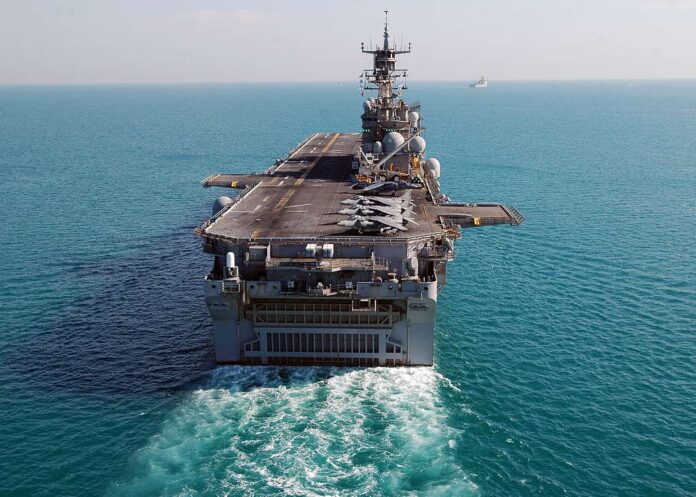
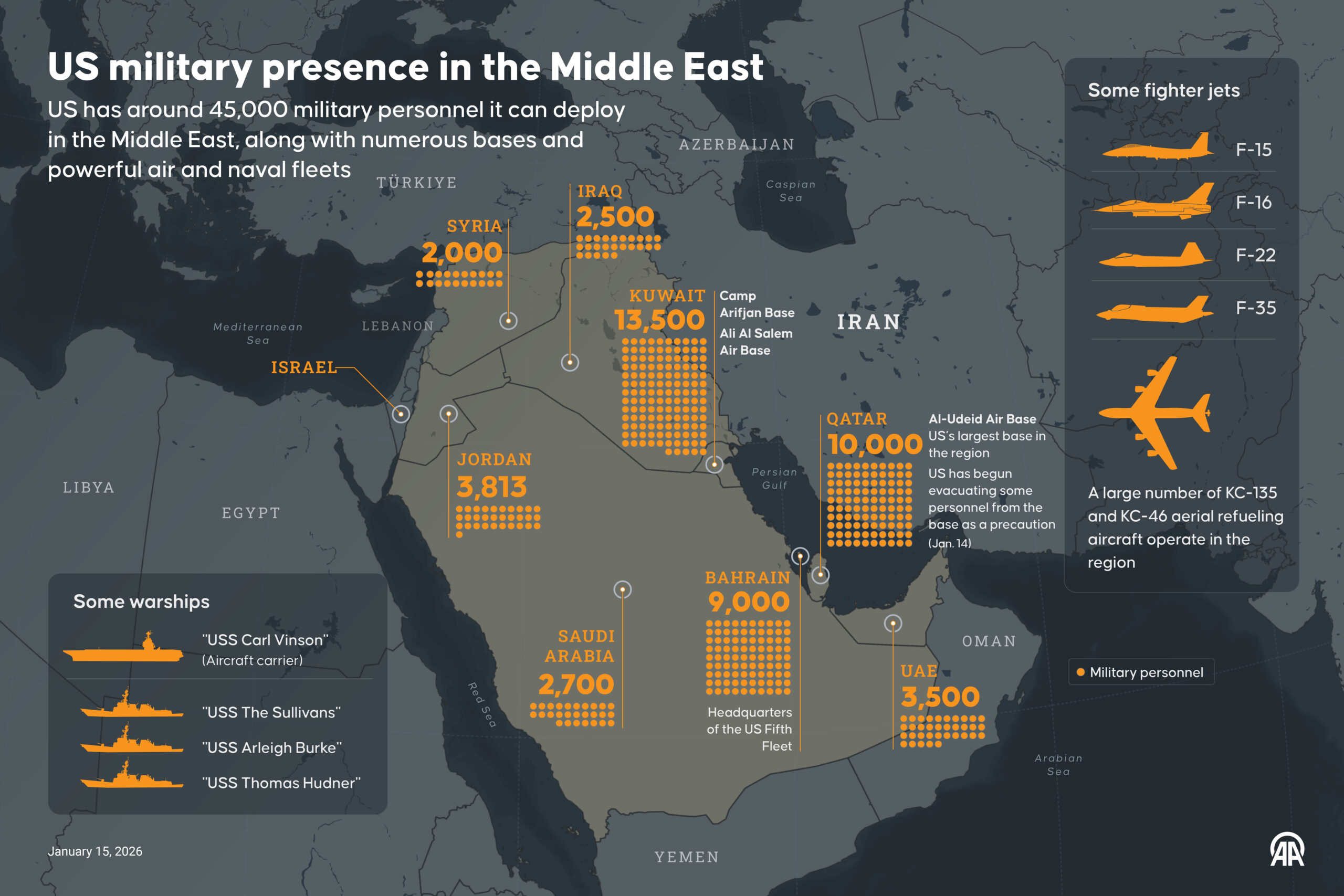
The centrepiece of the buildup is the USS Abraham Lincoln (CVN-72) Carrier Strike Group, redeployed from the South China Sea into the US Central Command area of responsibility and now operating in the Arabian Sea.
The carrier hosts Air Wing 9, including F-35C Lightning II stealth fighters, F/A-18E/F Super Hornets, and EA-18G Growler electronic warfare aircraft.

Escorting the carrier are three guided-missile destroyers — USS Frank E. Petersen Jr., USS Michael Murphy, and USS Spruance — joining other Arleigh Burke-class destroyers already in theatre. These vessels are equipped with Aegis missile defense systems and Tomahawk land-attack cruise missiles, providing the US with precision strike capability against targets inside Iran.
Pentagon officials have also confirmed that at least one nuclear-powered attack submarine is operating in the region, adding a stealth strike component to the naval force.
Alongside the naval buildup, the US Air Force has expanded its land-based strike posture.
Up to a dozen F-15E Strike Eagles from the 494th Expeditionary Fighter Squadron have been redeployed from RAF Lakenheath in the UK to Muwaffaq al Salti Air Base in Jordan. The aircraft are capable of long-range penetration missions and carrying bunker-busting munitions designed to target hardened Iranian infrastructure.
Aerial refueling assets, including KC-135 Stratotankers, are operating in the region, while intelligence platforms such as MQ-9 Reapers and RC-135W Rivet Joint surveillance aircraft have increased activity over the Gulf, likely monitoring Iranian radar and communications networks.
As offensive assets arrive, Washington has also moved to strengthen defences against potential Iranian ballistic missile retaliation.
A new Air Defence Operations Cell was activated at Al Udeid Air Base in Qatar in mid-January to coordinate regional missile defense. THAAD systems are deployed in Israel and the UAE, with Patriot batteries positioned across Qatar, Kuwait and Jordan.
The deployment of the Abraham Lincoln strike group and additional air assets has added approximately 5,700 US service members to the region, bringing total US troop levels in the Middle East to around 50,000.
Iranian response
Meanwhile, Iran’s foreign minister said on Wednesday that diplomacy cannot succeed under military pressure, rejecting negotiations with the United States while Washington increases its military presence and rhetoric toward Tehran.
“Our position is exactly this: exercising diplomacy through military threats cannot be effective or useful,” Foreign Minister Abbas Araghchi said in remarks carried by state news agency IRNA.
“If they want negotiations to take shape, they must certainly abandon threats, excessive demands, and the raising of irrational issues,” he said.
Araghchi said negotiations must be conducted “from an equal footing, based on mutual respect and for mutual benefit.”
“That one side seeks to achieve its objectives through force is unacceptable,” he said. “That is not diplomacy.”
“Negotiations under threat do not add up,” he added. “Talks can only take place when threats and excessive demands are set aside.”
The foreign minister said Iran is in regular contact with regional countries to prevent a potential conflict.
“Our contacts with them continue regularly and continuously,” he said. “Their ambassadors here are in direct contact with the Foreign Ministry. I am in contact with ministers; last night I spoke with Qatar’s foreign minister.”
Araghchi said there is broad regional agreement that any military action against Iran would destabilise the Middle East.
“This shared understanding exists across the region,” he said. “The region is completely against military threats, and everyone believes instability would lead to major challenges.”
Separately, Deputy Foreign Minister for Legal and International Affairs Kazem Gharibabadi said there are no formal negotiations underway between Tehran and Washington.
“At present, there are no negotiations with the United States, but messages are being exchanged,” he said.
Gharibabadi added that even if talks were to take place, Iran would not scale back its military preparedness.
“Even if Tehran and Washington sit at the negotiating table, this does not mean Iran will reduce its readiness for any potential war,” he said. “Our priority is not negotiating with the US, but getting prepared to defend our country.”