India and the United Arab Emirates have signed a $3 billion liquefied natural gas (LNG) supply agreement and have agreed to advance a strategic defence partnership.
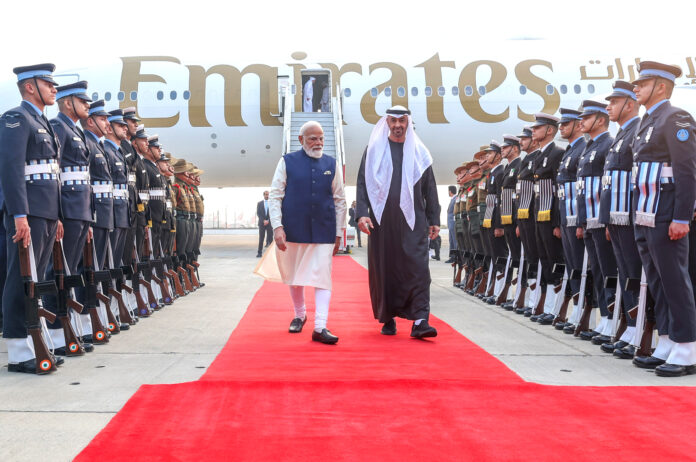
UAE President Sheikh Mohamed bin Zayed Al Nahyan met Indian Prime Minister Narendra Modi for a two-hour visit in Delhi yesterday, during which the agreements were announced.
Under the energy deal, Abu Dhabi-based ADNOC Gas will supply 0.5 million metric tonnes of LNG annually to India’s state-owned Hindustan Petroleum Corporation for 10 years. LNG, which is natural gas cooled to very low temperatures for transport by ship, is widely used for electricity generation, industry and domestic cooking.
ADNOC Gas said the contract raises the total value of its long-term LNG agreements with India to over $20 billion, making India its largest LNG customer worldwide.
“India is a key growth market and an important part of our long-term LNG strategy,” ADNOC Gas said.

India is currently the world’s fourth-largest LNG importer and depends heavily on overseas supplies to meet rising domestic demand. The UAE, a leading energy producer, is India’s third-largest trading partner after China and the United States. Bilateral trade spans energy, gold, food products, technology, construction and infrastructure.
Officials said the leaders set a target of $200 billion in annual bilateral trade within six years, nearly double current levels. India and the UAE signed a Comprehensive Economic Partnership Agreement in 2022 to reduce tariffs and expand investment flows.
Subscribe to our newsletter and stay updated on the latest news and updates from around the Muslim world!

Alongside the energy deal, the two countries signed a letter of intent outlining steps toward a strategic defence partnership, including defence cooperation, military training, institutional dialogue, and security coordination. Indian officials stressed the understanding is not a binding defence pact.
Sheikh Mohamed was accompanied by senior UAE officials, including the defence and foreign ministers, highlighting the talks’ importance. Analysts say the agreements come amid shifting political and security dynamics in the Middle East and South Asia.
India ruled out any regional military role. Foreign Secretary Vikram Misri said the partnership does not imply involvement in Middle Eastern conflicts. “Our involvement on the defence and security front with a country from the region does not necessarily lead to the conclusion that we will get involved in particular ways in the conflicts of the region,” he said.
Energy security was central to the talks. India imports more than 80% of its crude oil and about half of its natural gas, making long-term LNG contracts critical to price stability and supply. The UAE, already a major crude supplier, will now play a stronger role in India’s LNG needs.
Over the past decade, India has expanded relations with Gulf states, including Saudi Arabia, the UAE, Qatar, and Oman, driven by energy, trade, investment, and labour mobility. For the UAE, closer ties with India support market diversification beyond traditional Western buyers.
Officials said further technical discussions on defence, trade, and energy logistics are planned. LNG supplies are expected to begin once commercial and shipping arrangements are finalised.