

A Muslim nursing student in India’s western state of Gujarat claims he was briefly barred from an examination due to a fabricated anti-beard policy imposed by examiners, renewing concerns over Islamophobic discrimination in India’s education system.
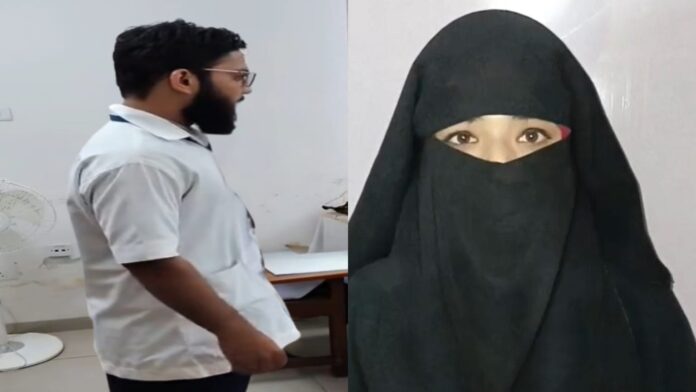
Abubakr Siddique, a student at a government-affiliated nursing college, said he was stopped from entering his viva exam on December 23 despite wearing the prescribed uniform, apron and face mask.
Speaking to 5 Pillars, Siddique said examiners repeatedly told him he was “not eligible” to appear for the exam because of his beard.
“I explained that I keep a beard for religious reasons,” he said. “They told me they did not want to hear any such explanations.”
Siddique said he pointed out that the Gujarat Nursing Council, the statutory body regulating nursing education in the state, has no rule prohibiting beards. He asked examiners to show him any written regulation but said none was provided.

“We have five marks for grooming. I politely said they could deduct those marks if they wanted, but allow me to sit the exam,” he said. “They refused.”
According to Siddique, the Gujarat Nursing Council had earlier issued a notice halting such restrictions and had sought an apology from institutions following complaints from students. Despite this, he said similar practices continue at college level.
Subscribe to our newsletter and stay updated on the latest news and updates from around the Muslim world!
After nearly two hours and intervention by senior college staff, Siddique was eventually allowed to appear for the exam. However, he said the incident affected his performance.
“A viva requires presence of mind,” he said. “After being spoken to disrespectfully and mentally harassed, I was exhausted.”
“This has been happening for the last three years,” he added. “You prepare seriously, and then you are humiliated at the door.”
The college administration did not respond to requests for comment.
Hijabi women discrimination
Siddique told 5Pillars that Muslim women students in his college face comparable barriers for observing hijab, the Islamic head covering.
“Many remove it because they have no choice,” he said. “Some are asked to uncover parts of their clothing in front of others. It is emotionally draining.”
He added that several Muslim male students attend exams clean-shaven out of fear of being barred or losing marks. Similar concerns have been reported elsewhere in Gujarat.
On December 24, Jenisha Shah appeared for a Railway Recruitment Board examination at a private centre in the state. She said she was stopped at the entrance and asked to remove her burkha and hijab.

After arguing with staff for more than half an hour, Shah said she was forced to leave without taking the exam.
“I told them to check me properly to ensure I wasn’t hiding anything,” she told 5 Pillars. “I asked them to show me any written rule banning hijab. They refused.”
She alleged that staff members mocked her and said Muslims were “the only ones who argue”, telling her to avoid exams if she wished to keep her hijab on.
“My faith is very close to me,” Shah said. “I cannot remove my hijab in front of men when I believe it is a religious obligation.”
She also referred to the Indian government’s Beti Bachao, Beti Padhao (Save the daughter, educate the daughter) campaign.
“They talk about educating girls, but we are not even allowed to sit for exams,” she said.
Shah’s friend, Nida Sheikh, said she has faced repeated obstacles in education and employment because she wears hijab.
“During a clerical recruitment exam, I was asked to remove it and spoken to rudely,” she said. “I had to leave without writing the exam.”
Sheikh also recalled harassment during her college years, saying she and another Muslim student were frequently targeted by male classmates chanting Hindu nationalist slogans.
“There were moments when groups tried to intimidate us,” she said. “The fear stays with you.”
Wider implications
Aliya Assadi, who was involved in protests against the hijab ban imposed in colleges in Karnataka’s Udupi district in 2022, said the incidents reflect a broader pattern.
“When religious identity becomes a barrier to education and employment, it raises serious questions about equality,” she said.
Another activist, A H Almas, said such experiences have long-term consequences.
“These are young people with ambitions,” he said. “When opportunities are denied because of identity, it affects entire families.”
Rights groups have warned that Muslims in India face increasing challenges in accessing education, employment and public services, particularly when visible religious markers such as hijab or beard are involved.
They argue that these incidents point to a pattern in which expressions of Muslim identity are treated as obstacles rather than constitutionally protected rights.
Legal experts note that India’s constitution guarantees freedom of religion and equality before the law, raising concerns about how such principles are applied at institutional levels.