


Bangladesh entered a period of mourning after the shock killing of Sharif Osman Hadi, a central figure of the July 2024 uprising, whose funeral in Dhaka drew hundreds of thousands amid rising political tension.
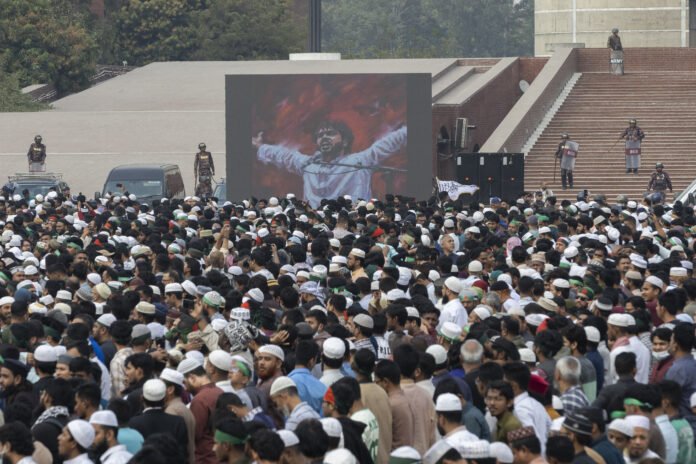
The funeral of Hadi took place before the national parliament in Dhaka, turning the area into a sea of people as supporters, diplomats, and political leaders gathered to pay their respects.
The government declared a state of mourning, reflecting the scale of public grief and the political weight of his death.
Hadi, a 32-year-old political activist and aspiring independent candidate for the Dhaka 8 constituency in the February 2026 elections, was shot in the head in central Dhaka earlier this month.
He later died in a hospital in Singapore after several days in critical condition. His death triggered violent protests, with buildings and media houses vandalised and set on fire in different parts of the capital.

At the funeral, interim government head Muhammad Yunus addressed the crowd, highlighting Hadi’s influence on grassroots politics. “Today, hundreds of thousands of people have come.
People are coming like waves on the road. At this moment, the eyes of millions of people are here. They are looking to know about Hadi,” Yunus said.
Subscribe to our newsletter and stay updated on the latest news and updates from around the Muslim world!
He added, “We should all adopt the process of elections that Hadi has taught us. How to run a campaign, how to reach the people – you have taught us everything. We have adopted this lesson.”
The killing
Hadi was shot in broad daylight on 12 December in the Paltan Bijoynagar area of Dhaka, shortly after Friday prayers. According to police and eyewitness accounts, attackers arrived on motorcycles and one assailant fired at close range before fleeing the scene.
He was first taken to Dhaka Medical College Hospital and later transferred to private facilities due to the severity of his injuries. Doctors eventually airlifted him to Singapore for advanced treatment, but his condition remained unstable and surgery could not be performed.
Authorities said a suspected activist of ousted Prime Minister Sheikh Hasina’s Awami League party was involved in the shooting.
Police have arrested multiple individuals in connection with the attack, while reports claiming the suspected shooter fled to India, a detail authorities have not independently confirmed.
Hadi’s death prompted strong reactions across Bangladesh’s political spectrum. Major opposition parties, including the Bangladesh Nationalist Party and Bangladesh Jamaat e Islami, issued statements mourning his death and demanding justice.
Student groups and supporters organised protests at Shahbagh, a central protest site in Dhaka. Demonstrators accused authorities of delaying the investigation and called for accountability as the country moves closer to national elections.
The United Nations also called for a proper investigation into the killing, adding international pressure on Bangladeshi authorities to ensure transparency and accountability.
A national hero
Sharif Osman Hadi rose to national prominence during the July 2024 mass uprising, which reshaped Bangladesh’s political environment and energised youth participation.
He was the convener and spokesperson of Inqilab Moncho, a youth led political and cultural platform that emerged as a mobilising force during the uprising, bringing together students and young activists through protests, public campaigns, and cultural programs to oppose injustice, discrimination, and political repression.
In the weeks before the attack, Hadi publicly warned that he was receiving death threats, including threats against his family. These warnings resurfaced after his death, fuelling anger and concern over political violence.
His killing has renewed fears about election related insecurity in Bangladesh, particularly for independent activists operating outside traditional party structures. Supporters say protests will continue until those responsible are brought to justice.