The U.S. Congress has voted for a bill that would end the harsh Caesar Act sanctions imposed on Syria during the rule of former dictator Bashar al-Assad.
The United States House of Representatives voted in a bill on December 10 to repeal the economic sanctions currently on Syria, as the country attempts to rebuild and distance itself from the Assad regime.
The bid was part of a larger defence spending package, known as the National Defense Authorization Act (NDAA).
Florida Representative Brian Mast said: “With this NDAA, as many know, we are repealing sanctions on Syria that were placed there because of Bashar al-Assad and the torture of his people.”
“We’re giving Syria a chance to chart a post-Assad future,” he continued.

Mast was previously opposed to dropping sanctions against Syria, as he still added a word of caution in his statement on Wednesday, that the White House could “reimpose sanctions if the president views it necessary.”
The bill is now heading to the Senate, and is expected to be voted on before the end of 2025.
Subscribe to our newsletter and stay updated on the latest news and updates from around the Muslim world!
If passed, the bill would lift the 2019 Caesar Act which had originally sanctioned the Assadist Syrian government for war crimes during the country’s 13-year-long civil war.
However, the repeal of the Caesar Act wouldn’t completely lift U.S. pressure on Syria, as the White House would require Syria’s new government to produce frequent reports on the government’s “fight against extremist groups” as well as the upholding of the rights of minority ethnic and religious groups in the country.
History of the Caesar Act
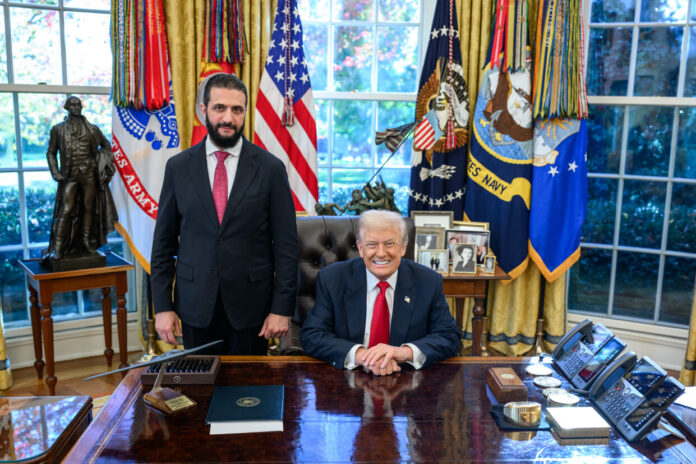
The Caesar Act was brought into effect during U.S. President Donald Trump’s first term. However, Trump has since lifted many existing economic sanctions on Syria and met with President Ahmed al-Sharaa, whom he called a “very strong leader.”

The lifting of the Caesar Act hasn’t been as straightforward as many may think. Despite Assad being long gone, Syria still faces the real threat of Israel in the south.
Just yesterday, Israeli Foreign Minister Gideon Sa’ar said that war with Syria “has become inevitable” following disagreements regarding security in southern regions of Syria.
“The gap between us [Israel] and Syria on the security agreement has grown. We are now farther from reaching an agreement than we were just a few weeks ago,” Sa’ar said.
It is partly for this reason that some Republican members have disagreed on the bill to lift the Caesar Act, with some pro-Israel lawmakers attempting to attach binding conditions to the repeal. These attempts have not been successful thus far, and the repeal remains untied to Israel.
The law to formally end the Caesar Act is scheduled to take effect on January 1, 2026, ending years of sanctions on Damascus.
A new Syria
The move would follow the Trump administration’s decision to remove Syria from the list of state sponsors of terrorism, and other related sanctions — a move which many criticised Trump for, citing al-Sharaa’s past as a “terrorist.”
Al-Sharaa has been lobbying hard to get sanctions removed, as well as increasing diplomatic and economic ties with other large players in the region, such as the Saudis.

The Caesar Act was named after the codename of an Assadist military photographer in the forensic unit in Damascus.
The unit would document and photograph the corpses of detainees who had died under torture from the regime. He smuggled approximately 55,000 photographs of 11,000 victims before defecting in 2013.
The archive became the most significant body of evidence implicating the regime in systematic torture and killing.
On December 8, 2024, Syrian opposition forces liberated Syria from the rule of Bashar al-Assad, as they stormed the capital under the leadership of current president, Ahmed al-Sharaa.
The day marked the end of a 53-year rule, starting with Bashar al-Assad’s father, Hafez al-Assad, in 1971.
The anniversary of Syria’s liberation was celebrated earlier this week with joy across the country, with millions pouring out onto the streets across major cities like Damascus, Homs, Idlib, Hama and more.