



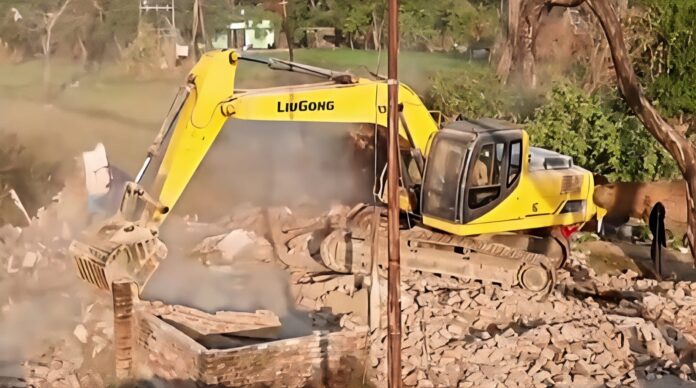
More than 90 Muslim families have been left homeless in freezing winter conditions after Indian authorities demolished what they described as illegal houses in the Himalayan state of Uttarakhand.
The pre-dawn operation has sparked widespread anger and fear among local Muslims, who say they were targeted because of their religion and were given no legal notice before the demolition.
The demolitions began at around 5.30am on Sunday 7 December in Puchdi, a Muslim settlement in the town of Ramnagar in Nainital district. Bulldozers arrived under heavy police protection while residents were asleep, and the entire settlement was reduced to rubble within hours.
Officials say the homes were built illegally on land belonging to the Forest Department and that the process followed legal procedure. Residents rejected this, insisting they received no eviction notice, no opportunity to contest the order, and no chance to remove belongings as winter temperatures approached freezing. Videos filmed by locals show children shivering without blankets, elderly women crying beside the debris, and families searching for clothes, utensils and schoolbooks among the ruins. Temperatures in the Himalayan foothills often fall close to zero in December.
Targeting Muslims

Residents say the demolition targeted only Muslim homes while neighbouring Hindu houses were left untouched. Human rights activists in Uttarakhand say the incident fits a broader pattern of demolitions against Muslim communities across states governed by the ruli ng Bharatiya Janata Party (BJP), with similar operations recorded in Uttar Pradesh, Madhya Pradesh and Assam, often without rehabilitation. A social worker in Haldwani accused the state of acting without accountability and said Muslims increasingly feel like second-class citizens.
The demolitions follow recent actions against mosques, madrasas and Muslim shrines in Uttarakhand, deepening insecurity among the state’s Muslim minority. Among the displaced is Khurshid, a 60-year-old widow who says she has lived in the settlement her entire life. She said she lost all her belongings, including winter clothing. Another resident, Seema, who works as a domestic cleaner, said she and her three children have nowhere to go as temperatures drop.
Subscribe to our newsletter and stay updated on the latest news and updates from around the Muslim world!
The operation was supervised by Vivek Rai, the Additional District Magistrate of Nainital, who told reporters that the demolition was filmed with drones and that legal notices had been issued to affected families. Dozens of residents dispute this and say they were never informed. Some claim they bought the land years ago from local intermediaries for the equivalent of £2,000 to £3,000 and say they have receipts. Several asked why, if the homes were illegal, authorities allowed them to live there for years before suddenly evicting them in winter. Officials say an investigation will be carried out, but families argue this should have taken place before demolishing their homes.
Illegal demolitions
Journalists were blocked from entering the area on Monday 8 December, with police placing barricades and reportedly instructing media not to film the operation. Local reporters say the restrictions raise questions about transparency and suggest authorities wanted to limit public scrutiny. Rights groups note that demolitions in India are increasingly accompanied by heavy police deployment and media restrictions.
Legal experts say the demolition appears to breach constitutional protections and Supreme Court guidelines that require proper eviction procedures and rehabilitation, particularly when children and elderly residents are involved. A lawyer from Delhi who visited the site said the state had acted without due process and vowed to challenge the demolition in court.
As night fell, families were scattered across nearby lanes, staying with relatives or sleeping beside the ruins of their homes. Some lit small fires to keep warm; others tried to cover children with thin shawls pulled from the rubble. Residents say they either want their homes back or alternative accommodation where they can live with dignity. Many asked why Muslim citizens are repeatedly forced to prove they belong in their own country.
Officials say more action may follow in the coming weeks, leaving residents fearful that other Muslim settlements on forest land may also be targeted. With temperatures continuing to drop in the Himalayan foothills, families in Puchdi face cold nights without shelter and a growing belief that they are being punished because of their identity.