


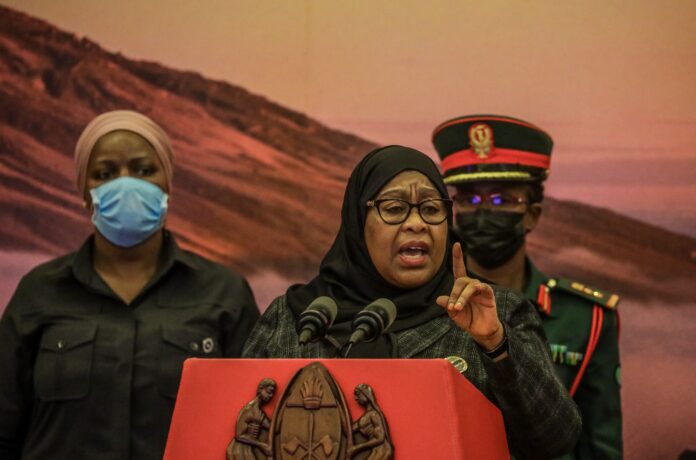
President Samia Suluhu Hassan has officially secured another term in office, winning approximately 98% of the vote in Tanzania’s presidential election.
The announcement made by electoral chief Jacobs Mwambegele comes amid nationwide unrest that has reportedly left hundreds dead and injured, raising serious concerns about democratic backsliding in the East African nation.
According to the electoral commission, just over 32 million ballots were cast, representing an 87% turnout among the country’s 37.6 million registered voters. In Zanzibar, which runs a semi-autonomous government, Chama Cha Mapinduzi (CCM) candidate Hussein Mwinyi was re-elected with nearly 80% of the vote.
Opposition parties quickly rejected the results, accusing the ruling CCM of “massive fraud” in Zanzibar and claiming the wider election was neither free nor fair.
Unrest and internet restrictions

Protests erupted in several cities, most notably in Dar es Salaam, where demonstrators tore down posters and attacked polling stations.
Although Saturday morning remained relatively calm, security forces maintained a heavy presence. Much of the unrest has been driven by young people who view the election as rigged, pointing to the exclusion of key opposition figures, one jailed on treason charges and another disqualified on technicalities.
Subscribe to our newsletter and stay updated on the latest news and updates from around the Muslim world!
Global internet observatory NetBlocks reported that mobile internet and social media access were restricted in multiple Tanzanian cities during and after the election.
A spokesperson for Chadema, the CCM’s main rival, claimed that around 700 people had been killed in clashes with security forces. A diplomatic source told the BBC that at least 500 deaths could be verified.
The government has downplayed the scale of violence, calling them “isolated incidents,” but international concern is mounting.
The UN, UK, Canada, and Norway have all issued statements expressing alarm over reports of fatalities and injuries linked to the government’s crackdown on protests.
Election without competition
President Samia’s landslide victory was widely expected — not because of broad-based democratic support, but due to the systematic exclusion of genuine opposition.
Samia, who previously served as vice president, became Tanzania’s first female president in 2021 following the death of John Magufuli. Initially viewed as a moderate reformer, she launched a policy known as the “four Rs” — reconciliation, resilience, reform, and rebuilding — which improved international relations and revived foreign investment.
But optimism faded as the political space tightened. Critics say repression under Samia has become even harsher than under her predecessor. Reports of abductions, torture, and targeted killings have increased, leading Freedom House, a US-based watchdog, to downgrade Tanzania’s status from “partly free” to “not free.”

The election saw the systematic sidelining of key opposition figures. Tundu Lissu, a prominent government critic, was arrested and charged with treason — charges he denies. His party, Chadema, was banned from participating, and his deputy, John Heche, was also detained.
Another would-be challenger, Luhaga Mpina of ACT Wazalendo, was disqualified twice despite a court ruling in his favour. Smaller parties were permitted to run but lacked the influence to mount a serious challenge.
Although 17 candidates appeared on the ballot, the absence of Chadema and ACT Wazalendo from serious contention effectively guaranteed a CCM victory.
Campaigns that once featured lively public debate were replaced with tension, intimidation, and censorship.
Reforms reversed
Samia’s early reforms briefly raised hopes for a democratic revival. Political rallies were allowed again, and opposition voices cautiously re-entered public life. Those gains have since been reversed.
Recent months have seen a surge in political violence, arrests, and extrajudicial killings. The abduction and murder of opposition official Ali Kibao, whose body was doused in acid, has become a rallying point for the opposition.
Tundu Lissu described the political situation as “deeply worrying” before his latest arrest. Chadema attempted to organise protests in response, but over 100 members were detained. Lissu, who previously survived an assassination attempt, had returned from exile to re-engage in national politics.
Global pressure on Tanzania’s government is growing. The UN and several Western governments have called for independent investigations into the killings and arbitrary arrests.
President Samia publicly condemned Kibao’s murder and vowed to deliver justice, but also criticised the international reaction. “It is surprising that the death of our brother Kibao has stirred such a huge outcry of condemnation, grief, and accusations calling the government murderers,” she said. “This is not right. Death is death. What we Tanzanians must do is stand together and condemn these acts.”
Though President Samia has claimed a commanding electoral mandate, the broader picture reflects a fractured democracy. The internet shutdown, suppression of dissent, and exclusion of opposition candidates have cast doubt on the election’s legitimacy.
For now, the government retains a firm grip on power. But as protests persist and diplomatic pressure mounts, Tanzania faces a deepening political crisis.
What began as an opportunity for the country’s first female president to usher in reform has instead become a test of how far Tanzania’s democracy has unravelled.
Tanzania’s religious make up is 64 percent Christian, 34 percent Muslim and 3 percent other.