




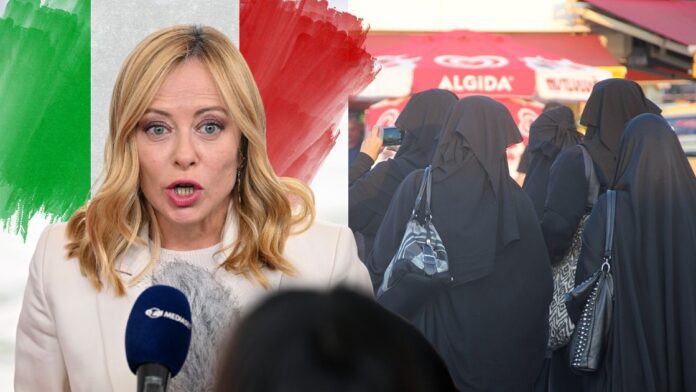
Italy’s ruling party has reintroduced plans to pass a series of strict laws to combat so-called “Islamic separatism”, such as banning the burqa and cracking down on the funding of mosques.
Italian Prime Minister Giorgia Meloni and her party, Brothers of Italy (FDI), have announced plans to tighten existing laws and introduce a bill banning the burqa and niqab in public spaces.
The bill to ban all Islamic face coverings, including the burqa and niqab, was discussed at a press conference on Wednesday, including senior members of the FDI party.
The harsh legislation would ban full-face Islamic veils in public spaces, with fines ranging from €300–€3,000 (£260–£2,600).
“This law addresses two needs: the safety of citizens, who must be able to know who they’re dealing with; and the need to avoid undermining women’s dignity, because erasing a woman’s face means undermining her dignity,” said MP Sara Kelany, the head of immigration for the FDI party.
The proposed law was originally filed in the Italian parliament in August as a law “to combat religious fundamentalism and separatism.”

Another criminal offence would aim to punish those “who propagate ideas based on religious superiority and hatred.”
Subscribe to our newsletter and stay updated on the latest news and updates from around the Muslim world!
Various Italian Muslim leaders have reacted to the recent developments.
Imam Massimo Abdallah Cozzolino of the Zayd Ibn Thabit Centre said: “Banning the full veil — which isn’t banning the veil itself — could be part of a security rationale. But legislation to this effect already exists, so I wonder what the actual utility of this proposal is.”
An opposition member of the Democratic Party, Pierfrancesco Majorino, also called the policy “hateful in terms of the message it conveys.”
Other aspects of the law seek to deal with matters surrounding Muslim marriages, such as introducing stricter penalties for arranged marriages, and “inducing marriages through religious coercion.”
The new law will also target Islamic groups or mosques which receive funding from abroad. They will be required to fully disclose any foreign funding to the state.
Such matters surrounding marriage would see the minimum prison sentence increased from 2 to 7 years.
According to the FDI party, they would also introduce two new criminal offences, punishable by two to five years’ imprisonment — namely, the examination and “certification” of female virginity.
The reasons behind Italy’s push to ban the burqa
The Brothers of Italy party has stated that these laws are to prohibit “cultural crimes”, and to prevent the spread of “Islamic fundamentalism” and “Islamic separatism.”
The legislation also imposes transparency rules on the funding of Islamic and other religious organisations that do not have formal agreements with the Italian state.
Through this, Muslim organisations would have to disclose all their funding sources, and government funding would only be guaranteed to entities that pose no threat to the state.
MP Andrea Delmastro said that the financial side of the legislation would aim to restrict the funding for the creation of places of worship in urban spaces.
Delmastro deemed this “necessary” because “it is quite clear that behind the financing of some illegal mosques, there may be soft power exercised by associations, bodies and third parties with other objectives contrary to state law.”
“The law against Islamic separatism represents a necessary step to protect the Italian identity… and the freedom of women,” said Kelany, an Italian MP under the Brothers of Italy party.
“Brothers of Italy reaffirms its commitment to the defence of Western values against all forms of radicalisation,” Kelany added.
The Brothers of Italy also said in a statement on 8 October: “Italy is a welcoming nation that defends the principle of cultural and religious freedom, but it cannot tolerate incidents stemming from extremism that conflict with our cultural and value system.”
Delmastro said Italy had drawn inspiration from France, the first European country to introduce a full burqa ban in 2011.
The UK right pushes similar ban
France was the first European country to introduce a blanket nationwide ban on the burqa in public in 2011.
Since then, 20 states have implemented some sort of ban on the burqa and other full-face coverings in public, such as Austria, Denmark, Tunisia, Belgium, Turkey, the Netherlands, and Switzerland.

British right-wing MP, Sara Pochin, who belongs to the Reform UK party, has given her full support to Giorgia Meloni over the burqa and niqab ban.
“Italy is following the lead of many other countries who put the security of their citizens first. I asked (UK Prime Minister) Keir Starmer to do the same in the interests of public safety. Starmer refused to answer my question,” Pochin said.
Pochin used her first ever PMQs question to demand a burqa ban, leaving Starmer and other MPs stunned.
A poll from July found that half of Britons believe Islam is not compatible with British values, believing that Muslim women are pressured into wearing the religious veil.
Pochin’s demands have been echoed by other right-wingers within British society, with Reform leader Nigel Farage calling the burqa “anti-British.” While right-wing media platforms GB News and Talk TV have held numerous discussions related to a British burqa ban and have echoed Reform UK’s anti-Islam stances.