


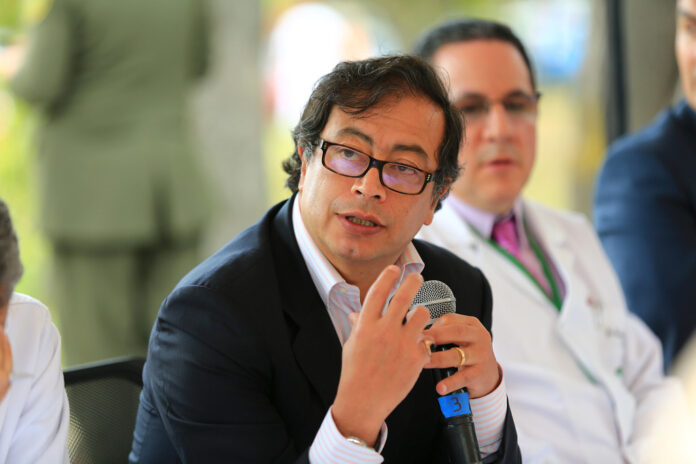
Who is Colombian President Gustavo Petro – the man who went where no Muslim leader has dared by urging the creation of an international coalition of nations and armies to fight Israel and liberate the Palestinians? Muhammad Siddeeq investigates.
In a world where diplomatic caution often prevails, Colombian President Gustavo Petro captured global attention with audacious statements on the Israel-Palestine conflict that have reverberated far beyond his nation’s borders.
At the recent United Nations General Assembly, Petro not only accused Israel and its allies of genocide but proposed the formation of an international military force to “liberate Palestine” — a stance no Muslim world leader has yet dared to articulate publicly.
His actions, both at the UN and on the streets of New York, have sparked a firestorm of debate, admiration and condemnation from the West.
So, who is the man behind these daring declarations?

A defiant voice
Petro’s appearance at the UN General Assembly was nothing short of electrifying. Addressing world leaders, he called for a coalition to militarily confront Israel in support of Palestine, a proposal that stunned the international community.
Subscribe to our newsletter and stay updated on the latest news and updates from around the Muslim world!
But Petro didn’t stop there. Taking to the streets of New York with a megaphone, he urged U.S. soldiers to defy orders from their Commander-in-Chief, former President Donald Trump, should those orders lead to civilian harm or war crimes.
“I am going back to Colombia to open enlistment for Colombians to serve in Gaza, and if I need to join myself, I will,” Petro declared, calling on other nations to contribute to a force “larger than that of the United States.”
The U.S. State Department responded swiftly, announcing the cancellation of Petro’s visa after his fiery address at a pro-Palestine rally in New York.
Undeterred, Petro returned to Colombia, where he followed through on his promise, opening enlistment for volunteers to fight alongside Palestinians in Gaza and urging other countries to follow suit.
In a video shared on his social media, Petro, speaking in Spanish to a large crowd, reiterated his call for a global coalition to support Palestine, with his translator amplifying his message to the world.
Who is Gustavo Petro?
Gustavo Francisco Petro Urrego, Colombia’s first-ever leftist president, is a complex figure shaped by a life of activism, intellectualism and rebellion.
Born into a middle-class family in the northern region of Córdoba, Petro grew up in Zipaquirá, near Bogotá, during a turbulent era marked by Colombia’s internal conflict between leftist guerrillas, paramilitary groups and the government.
These formative years, steeped in social injustice and political violence, forged his commitment to social equity and human rights.

Petro’s academic journey reflects his intellectual rigour. He studied economics at Bogotá’s Universidad Externado de Colombia, where he first became politically active, and later pursued postgraduate studies in economics and public administration, including a stint at the University of Salamanca in Spain.
A self-described agnostic in a predominantly Catholic country, Petro has consistently shown respect for Colombia’s diverse religious traditions, despite the nation having a negligible Muslim population.
His vocal support for Palestine, therefore, is not driven by domestic political pressures but by a deeply held conviction in global justice.
Petro’s political ideology — often labeled as progressive, leftist or democratic socialist —emphasises social justice, environmental protection and human rights. Known for his eloquent essays and speeches, he has earned both admiration and criticism for his uncompromising rhetoric and bold policy proposals.
His presidency, which began in 2022, marks a historic shift for Colombia, a nation long governed by conservative elites.
A revolutionary past
Petro’s bold stance on Palestine is not his first brush with radical action. In his early 20s, he joined the M-19 (Movimiento 19 de Abril), a leftist guerrilla group that combined urban insurgency with advocacy for social justice and democracy.
Active in the 1980s, Petro participated in M-19’s armed struggle against corruption and authoritarianism in Colombia. The group demobilised in 1990, transforming into a legal political party after a peace agreement with the government.
Petro’s militant past remains a cornerstone of his political identity, though he has since embraced democratic processes, emphasising peaceful governance since the 1990s.
This history of revolutionary activism lends credibility to Petro’s willingness to challenge global powers. His call for a military force to “liberate Palestine” echoes the audacity of his youth, when he fought for change in Colombia’s fractured society.
Global reactions: praise and silence
Petro’s proposal has elicited a polarised response. Nations like Venezuela, Bolivia, and South Africa have lauded his courage, with their leaders echoing his calls for solidarity with Palestine.
However, the silence from the Muslim world’s 55-plus leaders has been deafening. State-controlled media in countries like Egypt and Pakistan have reportedly avoided covering Petro’s statements, possibly to prevent sparking unrest among young Muslims eager to join the cause in Gaza.
As a leader from a country with no significant Muslim constituency, his outspoken advocacy for Palestine stands in stark contrast to the cautious diplomacy of others. Petro’s willingness to take such a stance, despite the diplomatic and personal repercussions, has cemented his reputation as a fearless — if controversial — global figure.
Gustavo Petro’s fiery rhetoric and bold proposals have thrust him into the international spotlight, raising questions about the role of non-Muslim leaders in advocating for Palestine.
His call for a military coalition to “liberate Palestine” undeniably challenges the status quo. And whether his vision will galvanise global action or remain a solitary cry in the wilderness, Petro has proven himself a leader unafraid to speak truth to power — no matter the cost.