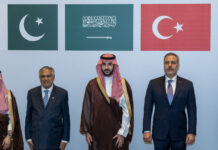




President Donald Trump held a high-profile meeting with Arab and Muslim leaders on Tuesday evening in New York, on the sidelines of the UN General Assembly to discuss the genocide in Gaza and the prospects for a ceasefire.
Those in attendance included the leaders of Qatar, Saudi Arabia, Turkiye, Pakistan, Egypt, Jordan, Indonesia and the UAE, in addition to US Secretary of State Marco Rubio and Trump’s special envoy Steve Witkoff.
At the outset, Trump described the gathering as “the most important” of his presidency, telling reporters: “We want to end the war in Gaza. We’re going to end it. Maybe we can end it now.”
He later added that the discussion was, “A very successful meeting with all the big players, except Israel. The next step will be a meeting with the Israelis. We’ll see what happens with Gaza, but it was a very good meeting with great leaders.”

Qatar’s Emir Tamim bin Hamad Al Thani expressed confidence in Trump’s role, stating: “We trust Trump’s leadership to end the Gaza war. The situation is dire, and we’re here to do all we can to stop the fighting and return the hostages.”

Turkish President Recep Tayyip Erdogan called the talks “productive and very good,” while the UAE said the session focused on ending hostilities, securing a lasting ceasefire, releasing hostages, and tackling Gaza’s worsening humanitarian crisis.
According to Axios, the meeting went beyond immediate calls for a ceasefire and humanitarian relief.
Subscribe to our newsletter and stay updated on the latest news and updates from around the Muslim world!
Trump’s team reportedly put forward a proposal for Arab and Muslim nations to send security forces into Gaza to enable an Israeli withdrawal, coupled with commitments to fund reconstruction and manage post-war governance.
Israel was not involved in the meeting but was briefed on the plan. It foresees some future role for the Palestinian Authority, though Israel has repeatedly rejected such an outcome.

The proposal ruled out any role for Hamas, which both the US and Israel insist must be disarmed and removed from governance in Gaza.
Trump has said Hamas cannot be rewarded for “horrible atrocities” and has called for the group’s elimination as part of any peace arrangement.
French President Emmanuel Macron also used his UN speech to highlight Gaza, one day after formally recognising the state of Palestine. Addressing the assembly, Macron declared: “Only the US president holds the leverage needed over Israel.”
He urged Trump to use his influence, adding in a separate interview that “if he wants the Nobel Peace Prize, he must end the Gaza war.”
Macron said a “credible plan” had been adopted by 142 states calling for an immediate ceasefire, hostage release, the dismantling of Hamas, and mutual recognition of Israel and Palestine.
France and Saudi Arabia, he noted, had played a role in building support for the declaration.
“This is a call for peace and broader regional stability, which Israel cannot achieve amid ongoing war with its neighbours,” Macron told delegates.
American reaction
Back in Washington, Secretary of State Marco Rubio took a sceptical line on Europe’s recent recognition of Palestine by the UK, France, Canada, Australia and Portugal.
Speaking on NBC, Rubio said such moves would play “little role” in ending the war. “No, not concerned at all,” he remarked, dismissing the recognitions as domestic political gestures.
Rubio also questioned what a two-state arrangement would mean in practice. “If there’s going to be a state, you need to know, well, who’s the government of that state?” he said on CBS, insisting that Hamas had no place in any future Palestinian administration.
For Trump, the meeting with Arab and Muslim leaders was presented as a breakthrough moment. Whether his proposals for security deployments and reconstruction funding gain traction remains to be seen.