


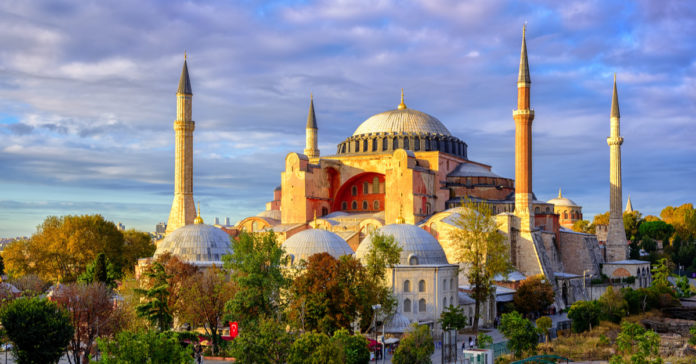
Roshan Muhammed Salih says a recent visit to the world-famous Aya Sofya Mosque in Istanbul left him appalled at its desecration by secular Turks who have no respect for its sanctity.
In 2020, Aya Sofya (Hagia Sophia) was reconverted into a mosque with much fanfare and celebration by Muslims. Originally a Byzantine church for nearly a thousand years, this magnificent building was turned into a mosque by Mehmet the Conqueror in 1453 before being transformed into a museum by the secular fundamentalist founder of modern Turkey, Kemal Ataturk.
I recall being among the minority of Muslims who believed its reconversion into a mosque was unnecessary, and thinking it was more about President Erdogan grandstanding and brandishing his Islamic credentials than anything else.
But over the years, I softened my opposition given the widespread joy among Muslims that one of the world’s greatest buildings would now be used to worship Allah.
So I was looking forward to praying my salah in Aya Sofya during a recent trip to Istanbul, but ultimately my experience left me questioning whether it has just been reduced to a chaotic tourist attraction masquerading as a place of worship.

Scantily-clad women
I walked into Aya Sofya’s main prayer hall around one hour before dhuhr to the sight of men (many of them non-Muslims) and women mixing freely, talking loudly and taking selfies.
Subscribe to our newsletter and stay updated on the latest news and updates from around the Muslim world!
Most women were appropriately covered, but some were clearly showing their hair, arms, and legs. Some of these women were non-Muslims (I’m not sure how they managed to get past security), but most seemed to have been Turks, judging by their speech.
Many of these women seemed oblivious to mosque etiquette, and were probably more familiar with nightclubs. And the masjid security did not remind them of it either.
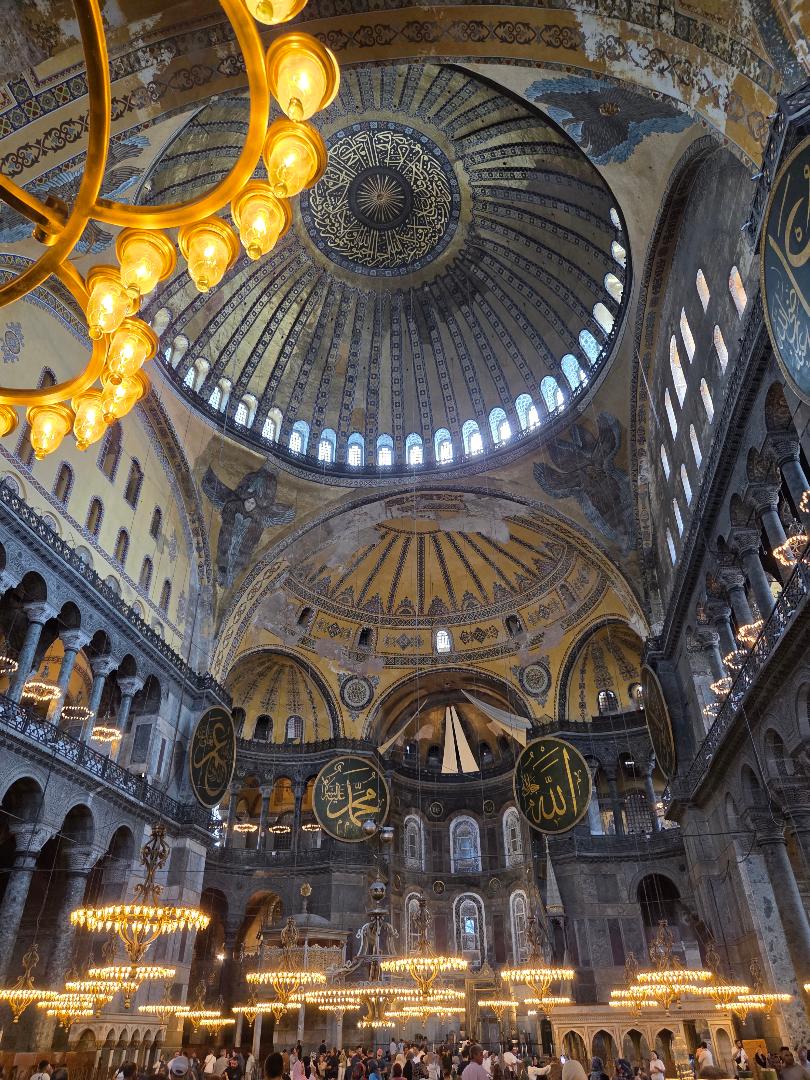
Hardly anyone was praying. Instead, the hall echoed with the chatter of tourists, and I spent most of my time avoiding getting in the way of group photos. Selfies dominated the scene, with visitors posing against the intricate mosaics and Quranic calligraphy, treating the space as an Instagram backdrop rather than a house of worship.
Photography, while understandable given Aya Sofya’s breathtaking beauty, seemed to take precedence over reverence.
In short, it felt more like a social gathering than a place of prayer. The only exception to this was a small area in front of the mihrab where men were praying unhindered, as well as the women’s section, which foreign Muslim women were obliged to stay in (having been barred from the main prayer hall, which seemed discriminatory).
To be fair, there were moments when Aya Sofya’s spiritual potential shone through after female tourists and scantily-clad Turkish women were cleared out as dhuhr began.
Standing in the prayer hall, I imagined Sultan Mehmet the Conqueror, who first converted the former cathedral into a mosque in 1453, standing in this very space. The pride of praying in a place so steeped in Islamic history is undeniable. Muslims from across the world flock here, their faces alight with awe as they perform salah beneath the soaring arches. The recitation of the adhaan and Quran is also exquisite, a reminder of the divine beauty this space can embody.
A missed opportunity
The Turkish government’s decision to reconvert Aya Sofya into a mosque was a bold, widely celebrated statement, but its execution feels half-hearted.
If Aya Sofya is to be a mosque, it should be treated as one unequivocally – complete with enforced dress codes, restricted photography and entry times for non-Muslims, and a clear prioritisation of worship over tourism.
As it stands, the current setup feels like an attempt to appease religious Turks, secular nationalists and the tourism industry – satisfying none.
The Christian iconography, still visible in patches of uncovered mosaics, adds another layer of complexity. For Muslims, these remnants of Aya Sofya’s Byzantine past are a distraction, even off-putting, in a space meant for Islamic worship.
Perhaps most troubling is the broader cultural context. Many Turks live in a state of jahiliyya – a disconnect from the spiritual and cultural roots of their faith. Aya Sofya, rather than serving as a beacon of renewal, mirrors this ambivalence. The pride of Muslims worldwide who come to pray here is palpable, but it is diluted by the lack of discipline and reverence in the space.
If Aya Sofya is to be a mosque, it must be more than a symbolic gesture. It demands a commitment to fostering an environment of true worship, not a photo-op for tourists or a political statement.
So in the end, my visit left me conflicted. I felt a swell of pride praying in Aya Sofya, connecting with centuries of Muslim history. Yet, I couldn’t shake the sense that its current state dishonours its sacred purpose.
Aya Sofya exists in a liminal space, a compromise that serves neither faith nor heritage well. If Turkey is serious about its role as a mosque, it must prioritise sanctity over selfies, worship over tourism. Otherwise, Aya Sofya risks becoming a hollow symbol, beautiful but bereft of the divine reverence it deserves.
You can follow Roshan on X/Twitter here.