


U.S. Special Envoy Tom Barrack has urged Israel to scale back its strikes in Lebanon and engage in negotiations with Syria as regional crises deepen.
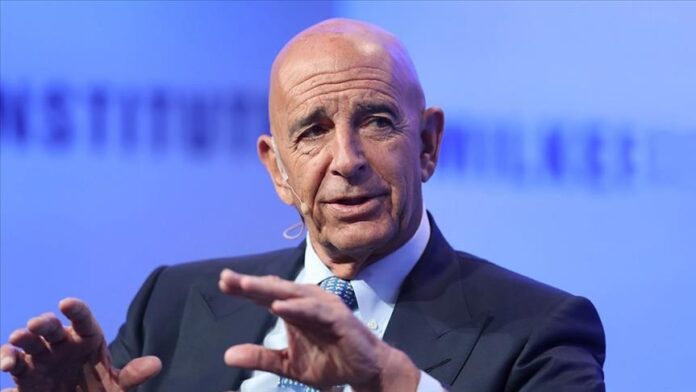
U.S. Special Envoy for Syria, Tom Barrack, met with Israeli Prime Minister Benjamin Netanyahu in Jerusalem on Sunday, calling for restraint in Lebanon and dialogue with Syria.
Barrack, who also serves as Washington’s ambassador to Turkey, was joined by U.S. Deputy Middle East Envoy Morgan Ortagus. He also met senior Israeli officials, including Strategic Affairs Minister Ron Dermer, Foreign Minister Gideon Saar, and Defence Minister Israel Katz.
According to Israeli media, Barrack conveyed a request from Washington that Israel “restrain its strikes in Lebanon” and consider “negotiations with Syria.”
His visit reflects growing international unease over Israel’s ongoing military operations and their potential to destabilise an already fragile region.

Strikes in Lebanon
Barrack’s message comes nearly a year after Israel launched its offensive in Lebanon on 8 October 2023. That campaign escalated into full-scale war by September 2024, leaving more than 4,000 people dead and around 17,000 injured.
Subscribe to our newsletter and stay updated on the latest news and updates from around the Muslim world!
The war stemmed from Hezbollah’s decision to launch rockets in support of Hamas as Gaza came under heavy Israeli bombardment. Israel retaliated with overwhelming force, pushing the conflict across Lebanon. By 27 November 2024, a ceasefire agreement was reached with French and American mediation. Under its terms, Israel was required to withdraw from southern Lebanon by 26 January 2025. When Israel failed to meet the deadline, the date was extended to 18 February. Today, Israeli forces remain stationed at five border outposts.

While Hezbollah has largely abided by the ceasefire, international monitors have logged hundreds of Israeli strikes and shelling incidents since the deal took effect.
These attacks are “officially justified” as targeting Hezbollah violations, but critics say they represent clear breaches of the agreement. Lebanon has filed formal complaints to the United Nations, while France has urged Israel to uphold its commitments.
Without penalties, however, the ceasefire has weakened, leaving displaced families unable to return to their homes in southern villages.
Talks with Syria
Alongside Lebanon, Barrack urged Israel to pursue negotiations with Syria. His appeal comes eight months after the dramatic fall of President Bashar al-Assad. In late 2024, opposition forces launched “Operation Deterrence of Aggression”, swiftly overrunning Aleppo, Hama, Homs and finally Damascus. Assad fled the country, ending more than five decades of a tyrannical family rule. An interim government under Ahmed al-Sharaa was formed in March this year after prisoners were released from regime facilities such as the notorious Sednaya prison.
The new authorities in Damascus face daunting challenges: reviving a shattered economy, integrating fragmented armed groups, and stabilising governance after years of civil war. Yet their efforts have been complicated by fresh sectarian unrest in Suweida province, home to Syria’s Druze minority. As soon as Assad fell, Israel launched unprovoked attacks across Syria and seized additional territory beyond the Golan Heights, drawing condemnation while intensifying fears of further destabilisation.

Despite these hostilities, the Syrian government and Israel have made light and cautious attempts at communication over certain practical issues. These contacts are limited, fragile, and often indirect, but they reflect a recognition on both sides that some level of dialogue may be necessary to manage flashpoints and avoid wider escalation. The United States, through envoys such as Barrack, is seeking to encourage more of these exchanges in the hope that it could serve as an opening toward broader negotiations and possible normalisation.
Israel’s role in Druze unrest
In July, violence erupted in Suweida following the abduction of a Druze merchant. Clashes broke out between Druze and Bedouin militias, joined at times by government forces. More than 1,100 people were reportedly killed in a week.
Israel launched strikes on Suweida, Damascus, and Deraa, claiming it was acting to defend the Druze against government-linked forces. While some Druze groups welcomed Israeli intervnention, others accused Tel Aviv of fuelling divisions to further its own strategic interests.
The Druze, who make up about three percent of Syria’s population, long held a precarious position under Assad, enjoying limited autonomy in return for loyalty to Damascus. Since Assad’s ouster, many have resisted integration into the Syrian army, relying instead on local militias.

This dynamic fits a broader Israeli approach: cultivating ties with regional minorities. Over the decades, Israel has sought alliances with Druze, Kurds, Alawites, and even Christian groups, portraying itself as their protector.
Critics describe this as a “divide and rule” strategy that fragments the region, while Israeli officials argue it creates necessary security buffers.
In the current context, Israel’s support for the Druze has become both a rationale for military action in Syria and a means to pressure the new Syrian authorities.
Regional reactions
Israel’s continued strikes in both Lebanon and Syria have drawn broad criticism. Arab states, including Iraq, Qatar, Egypt and Saudi Arabia have condemned the raids. Turkiye also called them an act of sabotage against Syria’s fragile transition, while Iran labelled them predictable. UN Secretary-General Antonio Guterres also expressed concern, describing them as “escalatory”.
Israel maintains that both Hezbollah in Lebanon and armed groups in Syria represent existential threats that justify continued military action.
Barrack’s meetings underscore the delicacy of the current moment. In Lebanon, a ceasefire exists largely in name, eroded by Israeli violations. In Syria, the post-Assad government faces sectarian divisions and outside pressure as it attempts to consolidate power.
For Washington, urging Israeli restraint is less about moral leadership and more about preventing another regional war. For Israel, military operations are presented as indispensable to national security. For Syria’s interim authorities, the priority remains survival in the face of internal unrest and external aggression.
As Israel weighs its next moves, the region stands at a precarious crossroads. Whether restraint and dialogue prevail, or conflict deepens further, will shape the trajectory of both Lebanon and Syria in the months ahead.