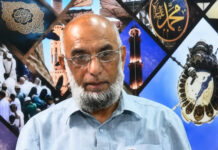




Muslim YouTuber Mohammed Hijab has questioned the UK justice system’s fairness after losing a defamation case against pro-Israel writer Douglas Murray and The Spectator.
The High Court’s Jeremy Johnson dismissed a libel claim brought by Hijab after finding the magazine’s reporting was “substantially true” and that Hijab had not suffered serious harm as a result of their reporting.
Following the verdict issued in early August, Hijab took to social media and criticised the judge, the verdict and some Muslims for unquestioningly accepting Johnson’s ruling on August 9.
“I have no concern for the enemies of Islam, what they say is to be expected. What is deeply troubling, however, is that some Muslims unquestioningly accept Jeremy Johnson’s ruling as if it were wahy (divine revelation). This is not only un-Islamic, but also deeply misguided.
“Johnson, who was previously a defence lawyer for both MI5 and the UK Ministry of Defence, dismissed serious allegations of torture of Iraqis in the Al-Sweady Inquiry by asserting there was ‘no credible evidence.’ Many of the so-called lies he accused me of actually pertained to protests and discussions with Jews in Golders Green, entirely unrelated to the events in Leicester.

“Furthermore, Johnson offered no compelling reasoning for branding these statements as lies only his own inferences. My sole error was placing too much faith in the UK justice system’s fairness. I understand my enemies will want to use this message to put me in prison for contempt of court and that the same judge has already given others prison sentences for the same thing. I am ready for any subsequent injustice as I have Allah on my side. I would rather be in prison in a cell than be a prisoner in the open.”
Hijab also posted on August 6: “A sincere thanks to my enemies you worked harder than anyone to make me significant.”
Subscribe to our newsletter and stay updated on the latest news and updates from around the Muslim world!
The Hijab defamation case
The reporting centred on tension between British Hindus and Muslims in Leicester which erupted into street violence in the summer of 2022.
Amid the unrest, Hijab travelled up to Leicester and gave a street speech about the Hindu nationalist ideology Hindutva which was then posted to his Youtube channel, on 18 September 2022.
Days later The Spectator’s Douglas Murray wrote of the “downside with diversity” and what had happened in Leicester. He said: “Soon charming people like Mohammed Hijab, who rotates between presenting himself as a reasoned interlocutor and a street agitator, arrived on the scene.”
Hijab sued The Spectator and Murray, claiming damages for losses resulting from three organisations that had disassociated themselves from him following the publication of the article.
Johnson described Hijab as “highly educated” but “combative and constantly argumentative” on the witness stand. He also described the claimant as having displayed “palpable personal animosity” towards Murray.

The judge found: “Specifically, I am satisfied that he lied in respect of the event at Golders Green, the counter-protest at the rally for Israel, the seminar on Hinduism at the Sapience Institute, his repudiation of vigilantism, his evidence as to the involvement of the Hindutva, his evidence about his choice of language in his speech, and his evidence in support of his claim for financial losses,” referring to a series of events in which Hijab had appeared in the run-up to the Leicester speech.
The judge decided that Murray’s article conveyed the meaning that: “The claimant is a street agitator who has whipped up a mob on London’s streets, addressed an anti-Israel protest in inflammatory terms, and exacerbated frayed tensions (which had already spilled over into public disorder) between Muslim and Hindu communities in Leicester by whipping up his Muslim followers including by ridiculing Hindus for their belief in re-incarnation and describing Hindus as pathetic, weak and cowardly in comparison to whom he would rather be an animal.”
He said this was a statement of fact which is defamatory of Hijab, but that The Spectator had not caused, and was not likely to cause going forward, serious harm to his reputation.
The judge also said it seemed Hijab “positively revelled in any form of publicity” and noted that material published by him was “at least as reputationally damaging to him as the article” because he posted video showing himself “directly whipping up a large group of masked men and ridiculing a central tenet of Hinduism.”
The judge said the description of Hijab as a “street agitator who has whipped up a mob on London’s streets” and as someone who “addressed an anti-Israel protest in inflammatory terms” was an “accurate description” of what he was seen to be doing at a rally for Israel.
The Spectator’s legal team brought up other incidents of Hijab attending anti-Israel events in London, one in Golders Green and another close to the Israel Embassy, as part of their defence.
Hijab has since revealed via his X account that he has now been demanded to pay an eye-watering £670,000 in costs as a result of the loss.