


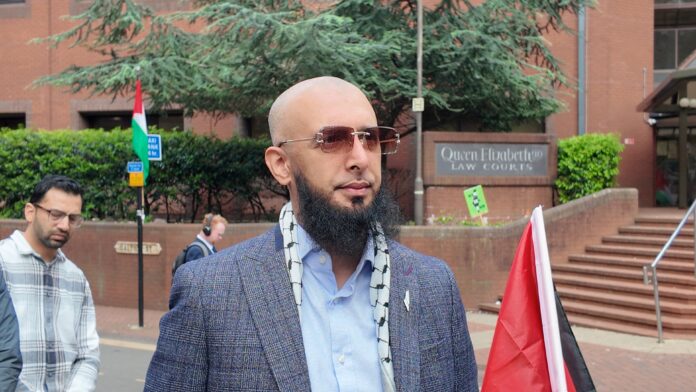
Pro-Palestine activist Majid Freeman is awaiting the jury’s verdict after a two-week terrorism trial at Birmingham Crown Court.
Freeman, 38, from Leicester, faces two charges of encouraging terrorism and supporting a proscribed organisation (Hamas).
The charges relate to his activity on social media platforms Twitter/X and Instagram in 2023 and 2024.
Prosecutors allege that he deliberately encouraged terrorism and openly supported Hamas, while his defence team says he does not support Hamas but supports “Palestinian resistance” instead.
The jury could return a verdict as soon as Wednesday, May 6.

Prosecution case
On the first count, prosecutors allege that Freeman used his considerable social media presence to promote and encourage acts of violence.
Subscribe to our newsletter and stay updated on the latest news and updates from around the Muslim world!
Central to their case is a post dated March 11, 2024 referencing the Charlie Hebdo killings, which they argue went beyond commentary and amounted to endorsement of violent action.
The prosecution told the court that Freeman used coded language to communicate with a large audience of followers. They argued that his messaging was deliberate and designed to influence like-minded individuals.
“He was not a passive observer,” the prosecution said. “He was actively seeking to persuade others to act.”
His mobile phone, the court heard, was effectively “a weapon,” used to disseminate ideas that could inspire real-world violence. Prosecutors claimed he was “gambling with other people’s lives” by encouraging followers to act using whatever means they had available.
On the second count, the prosecution alleges that Freeman repeatedly expressed support for Hamas, a group proscribed in the UK since 2021. They pointed to videos and imagery he shared, including content associated with the group’s military wing and figures such as Abu Obaidah and Sheikh Ahmed Yassin.
The court was told that Freeman used symbols, including a red triangle, which prosecutors is linked to Hamas, and that his posts consistently “amplified Hamas’s voice.” They described him as an “effective propagandist” who used short videos and messaging to “humanise” the group and build long-term support.
“This case is not about the Palestinian issue,” the prosecution emphasised. “It is about applying the law.”
Defence case
On the other hand, the defence argued that Freeman’s actions must be understood in the context of the ongoing conflict in Gaza, which they described as a genocide.
His legal team said his posts reflected “desperation” at the suffering of Palestinians and were part of broader political expression rather than criminal intent.
“He is not an extremist. He is not a jihadi,” the defence told the jury. “He is a conventional Muslim who cares deeply about human life.”
They highlighted Freeman’s background as a charity worker involved in tackling knife crime and homelessness, as well as his visits to Gaza in 2012 and 2013, where he delivered medical aid.
According to the defence, Freeman supports the principle of armed resistance in self-defence but does not support terrorism. They stressed that he opposes attacks on civilians, including the Charlie Hebdo killings, and does not endorse hostage-taking.
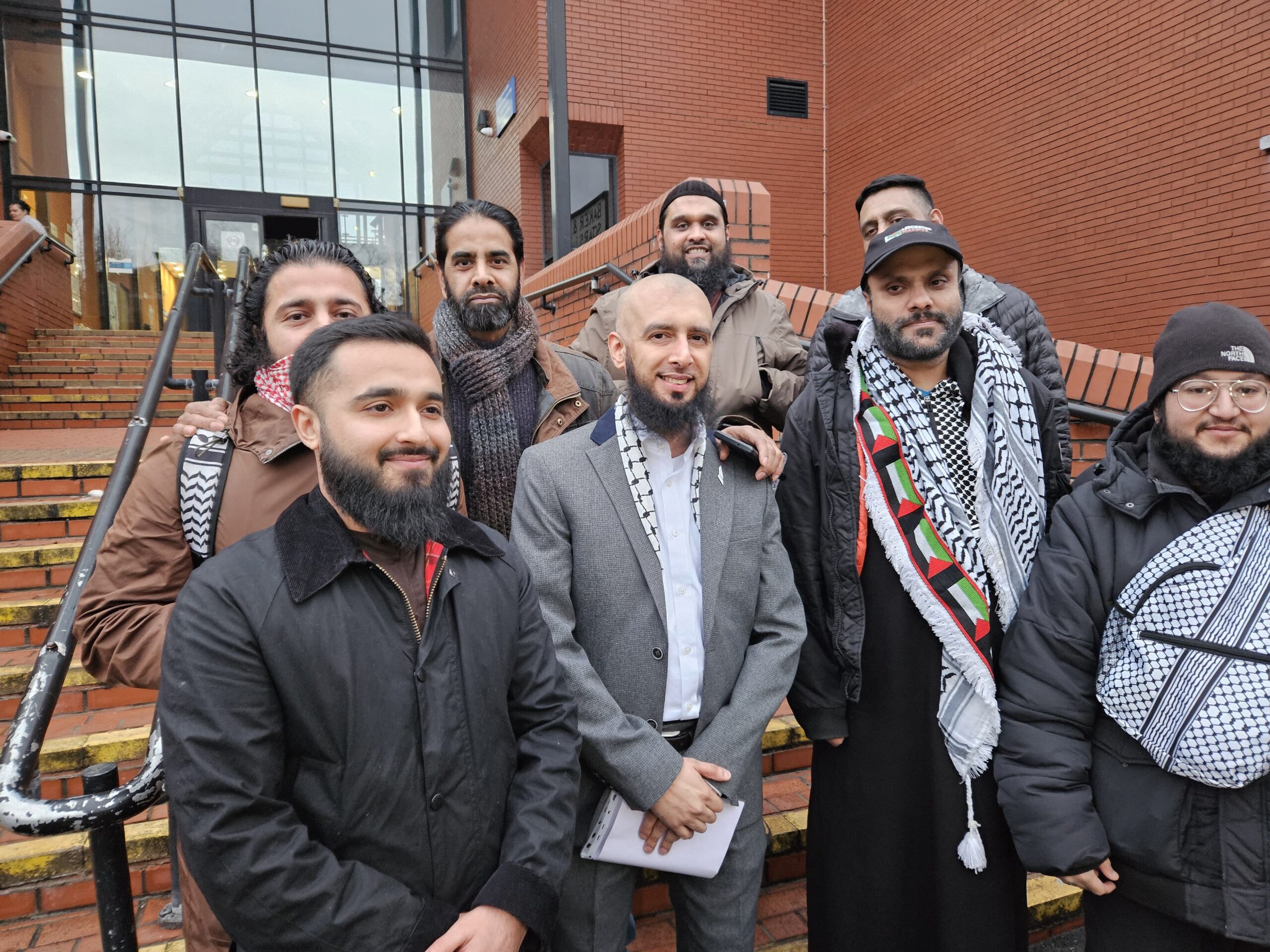
Addressing the March 11 post, the defence described it as “a poorly judged attempt at discussion” rather than an incitement to violence.
They also challenged the interpretation of symbols and language used in his posts. The red triangle, they argued, is widely used as a general symbol of solidarity with Palestinians, not evidence of support for Hamas.
An expert witness, Professor Fawaz Gerges, testified that the imagery and rhetoric used by Freeman should be seen within the broader context of Palestinian resistance and the humanitarian situation in Gaza, which he described as an “open-air prison.”
The defence maintained that Freeman never explicitly supported Hamas as an organisation, instead expressing solidarity with Palestinians and what he viewed as a legitimate struggle for survival.
His use of hashtags such as #gazaresists, they argued, reflected a focus on the broader cause rather than any specific group.
“He was trying to draw attention to what he believed was a genocide,” the defence said. “Social media is fast-moving and often harsh, but his intention was to raise awareness, not to incite violence.”
They concluded by urging the jury to set aside prejudice and focus on the evidence, portraying Freeman as a man “driven by humanity and faith” who felt compelled to speak out after witnessing suffering firsthand.