



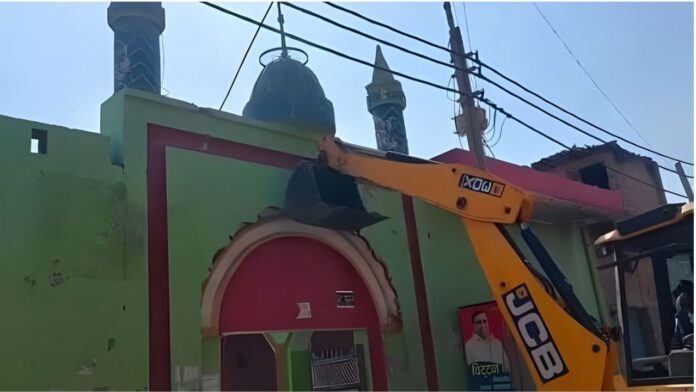
Indian authorities demolished an Islamic seminary in Uttar Pradesh’s Sambhal district on Thursday, triggering anger and anxiety among local Muslims who say the action was sudden, heavily policed and carried out without warning.
The demolition took place in Naroli town under Chandausi tehsil, where officials said the Darul Uloom Madrasa had been constructed on public land classified in government revenue records for civic use, including compost pits and a public road.
District authorities described the operation as part of an anti-encroachment drive targeting illegal constructions. Residents, however, questioned the process and pointed to a broader pattern of bulldozer demolitions targeting Muslim-only infrastructure across Uttar Pradesh.
From early morning, Naroli’s Banjari Koan locality was placed under heavy security, with police personnel from five stations and a unit of the Provincial Armed Constabulary (PAC) deployed before the demolition began.
Madrasa staff and residents were seen removing religious books, desks and furniture while officers formed a security cordon around the site. Senior civil and police officials supervised the operation.

“It felt like the entire neighbourhood had been turned into a restricted zone,” said Mohammad Rashid, a nearby shopkeeper.

Editorial credit: arindambanerjee / Shutterstock.com
“There were police vehicles everywhere and people were afraid to step outside.”
Subscribe to our newsletter and stay updated on the latest news and updates from around the Muslim world!
Shops remained partially closed and movement through narrow lanes was restricted as police patrolled the area to prevent gatherings.
Sub-District Magistrate Ashutosh Tiwari said the demolition was carried out under Section 67 of Uttar Pradesh revenue laws, which allows authorities to remove unlawful occupation of government land.
“We issued notices twice and provided sufficient time to remove the constructions,” Tiwari told reporters. “As there was no compliance, action was taken against the illegal structures, including the madrasa.”
Officials said eight to ten nearby houses built on the same plots, numbered 1635 and 1636 in land records, have also been declared illegal and may face demolition.
The administration maintained that the drive was routine and not directed at any particular religious group.
“This is purely an administrative action based on revenue documents,” Tiwari said.
Mosque, madrasa and other Muslim infrastructure has become the routine target of the bulldozer in India in recent years in a trend local activists have accredited to the ongoing persecution of Muslims in India by the Islamophobic Hindutva authorities.
Hindutva is a Hindu supremacist ideology which has risen to power in India. It preaches intolerance and sectarianism and specifically encourages violence against Indian Muslims and Christian minorities.
Local outrage
Local representatives and residents challenged the administration’s account, saying proper consultation and communication did not take place.
Naroli Nagar Panchayat chairman Bittan Malik said he had not been formally informed despite being an elected local authority.
“The madrasa is a religious and educational institution that has existed for years,” Malik said. “If there was a land dispute, the local body should have been consulted.”
Residents said the madrasa served children from low-income families, providing Islamic education alongside basic subjects.
“This madrasa was teaching our children,” said Abdul Hameed, whose nephew studied there. “Private schools are expensive. Now we don’t know where our children will go.”
Shabana Begum, whose home has reportedly been declared illegal, said families are living with uncertainty.
“We have lived here for years,” she said. “Suddenly we are told our house is illegal. We are daily wage workers. Where should we go?”
Several residents watched the demolition from a distance as the structure was reduced to rubble.

The incident has renewed debate over what critics and rights groups describe as “bulldozer justice” in Uttar Pradesh, India’s most populous state, where demolitions of alleged illegal structures have become a prominent administrative measure since Chief Minister Yogi Adityanath took office in 2017.
Supporters say the policy enforces law and removes unlawful encroachments, while critics argue that demolitions disproportionately affect Muslims and economically vulnerable communities.
A local social activist, speaking on condition of anonymity, said residents perceive a recurring pattern.
“Whenever such drives happen, they are mostly in Muslim neighbourhoods,” he said. “Transparency is essential if authorities want public trust.”
Legal experts note that Indian law permits removal of illegal structures but requires adherence to procedural safeguards, including clear notices and opportunities to challenge decisions in court.
Advocate Sameer Khan, a lawyer practising in the district court told Clarion India, affected parties retain legal remedies.
“If notices were issued, they must clearly explain the grounds and allow reasonable time for response,” he said. “Residents can approach the courts if they dispute ownership or procedure.”
He added that demolishing religious structures requires particular caution given India’s sensitive communal environment.
Local Muslim leaders expressed sorrow over the incident but urged residents to maintain peace.
“A madrasa is not just a building; it is a centre of education and faith,” said Maulana Farooq Ahmad, a cleric from a nearby town. “If there were land issues, dialogue could have resolved them.”
Officials said the situation remained under control following the demolition. Community members said discussions are ongoing over whether madrasa authorities or affected residents will pursue legal action in court.