

An attacker opened fire at the gates of a Shia mosque in Islamabad, Pakistan, before detonating a suicide bomb which killed at least 31 people, making it Islamabad’s deadliest terror attack in a decade.
The deadly attack on Friday February 6 at a Shia mosque injured a further 170 people.
The attacker had begun his attack at the gates of the Khadija al-Kubra Imambargah compound on the outskirts of Islamabad, officials said. The attacker detonated a bomb after guards had challenged him upon entering the compound on Friday after morning prayers.
Officials are currently investigating the blast at the Khadija al-Kubra mosque, with the death toll expected to rise as hospitals deal with casualties who are in critical condition.
Harrowing scenes

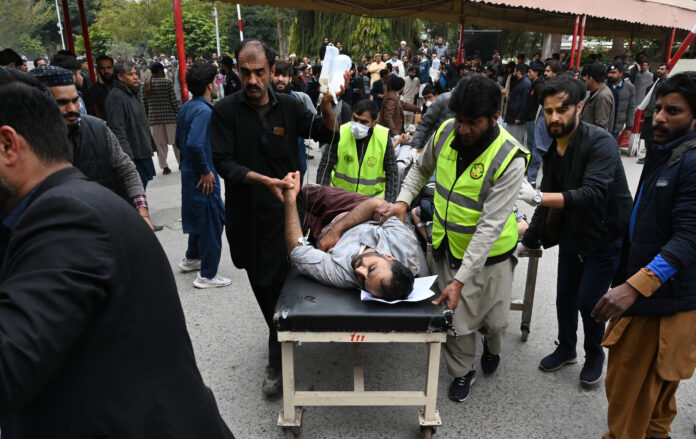
Television footage and social media images following the blast show scattered injured and dead bodies as police and residents frantically transport the wounded to nearby hospitals.
Rescuers and the injured at the scene described the situation as chaotic and particularly distressing, as bloodied bodies lay on the carpeted floor of the mosque.
Subscribe to our newsletter and stay updated on the latest news and updates from around the Muslim world!
Hussain Shah said he was praying in the courtyard of the mosque when a sudden loud explosion was heard.
“I immediately thought that some big attack has happened,” Shah told the Associated Press.
Upon entering the mosque, Shah recounted the screams he heard from the injured as many cried out for help. There were around 30 bodies inside, which Shah counted, while those injured appeared to number in the hundreds.

“People were lying in pools of blood. I saw people’s heads and limbs separated from their bodies,” he said.
No official terrorist group has claimed responsibility for the attack thus far.
Pakistani officials respond
Pakistani Defence Minister Khawaja Asif wrote on X: “The man blew himself up in the last row of worshippers.”
He said that the bomber had a history of travelling to Afghanistan and blamed neighbouring India for sponsoring the attack, although no further evidence was provided, nor was the attacker named.
Mosharraf Zaidi, Prime Minister Shehbaz Sharif’s spokesman, said the attack at the Shia mosque in Islamabad “is only the latest in a series of murderous terrorist attacks orchestrated by India”.
“India’s terrorist proxies will neither slow down economic recovery, nor divide Pakistani hearts, nor undermine Pakistan’s growing diplomatic capital,” Zaidi stated on X.

New Delhi has not replied to the allegations but has staunchly dismissed similar accusations of backing extremist militants in the past.
Deadliest attack in a decade
The attack is reported as the deadliest suicide bombing in Islamabad in more than a decade, according to conflict monitor ACLED, which said it “bears the hallmarks of the Islamic State”.
Shia Muslims are a sizeable minority in Sunni-majority Pakistan, estimated at roughly 10–15% of the country’s 241 million population.
Shia Muslims have been targeted in the past through sectarian violence, including attacks carried out by Islamic State and other militant groups in the country.
The government of the Islamic Emirate of Afghanistan have condemned the attack, with the foreign ministry saying that such an attack “violates the sanctity of sacred rituals and mosques and targets worshippers and civillians.”
Mass bombings of this nature are rare in Islamabad, the heavily guarded capital, but Pakistan has dealt with a surge in militant attacks in recent years along the Durand Line, its shared border with Afghanistan.
The last deadliest attack in Islamabad took place in 2008, when a suicide bombing targeted the Marriott Hotel, killing 63 people and injuring more than 250 others.
In November last year, a suicide bomber also detonated outside a court in Islamabad, killing 12 people.