




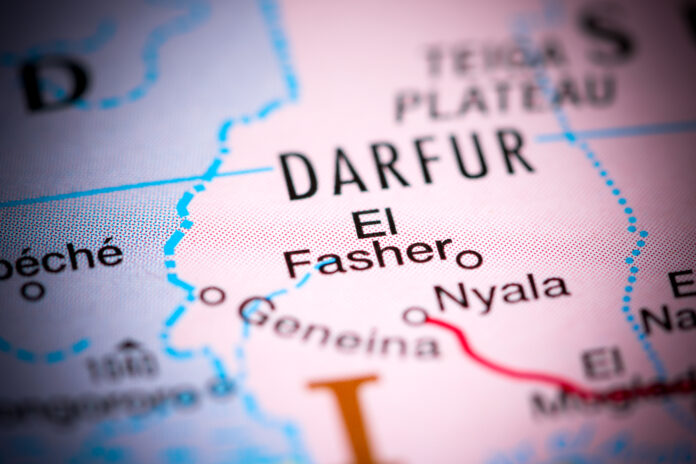
The fall of El-Fasher city on Tuesday marked a major escalation in Sudan’s brutal civil war between the Sudanese army, led by General Abdel Fattah al-Burhan, and the UAE-backed paramilitary Rapid Support Forces (RSF).
More than 2,000 civilians, including women and children, have been reportedly killed by RSF fighters in El-Fasher over the past 48 hours. The massacre follows months of siege by tens of thousands of RSF troops who encircled the city in April 2024.
Food supplies were cut off, and systematic killings of civilians began soon after. Hospitals were overwhelmed, the nearby Zamzam displacement camp was destroyed, and humanitarian aid was blocked.
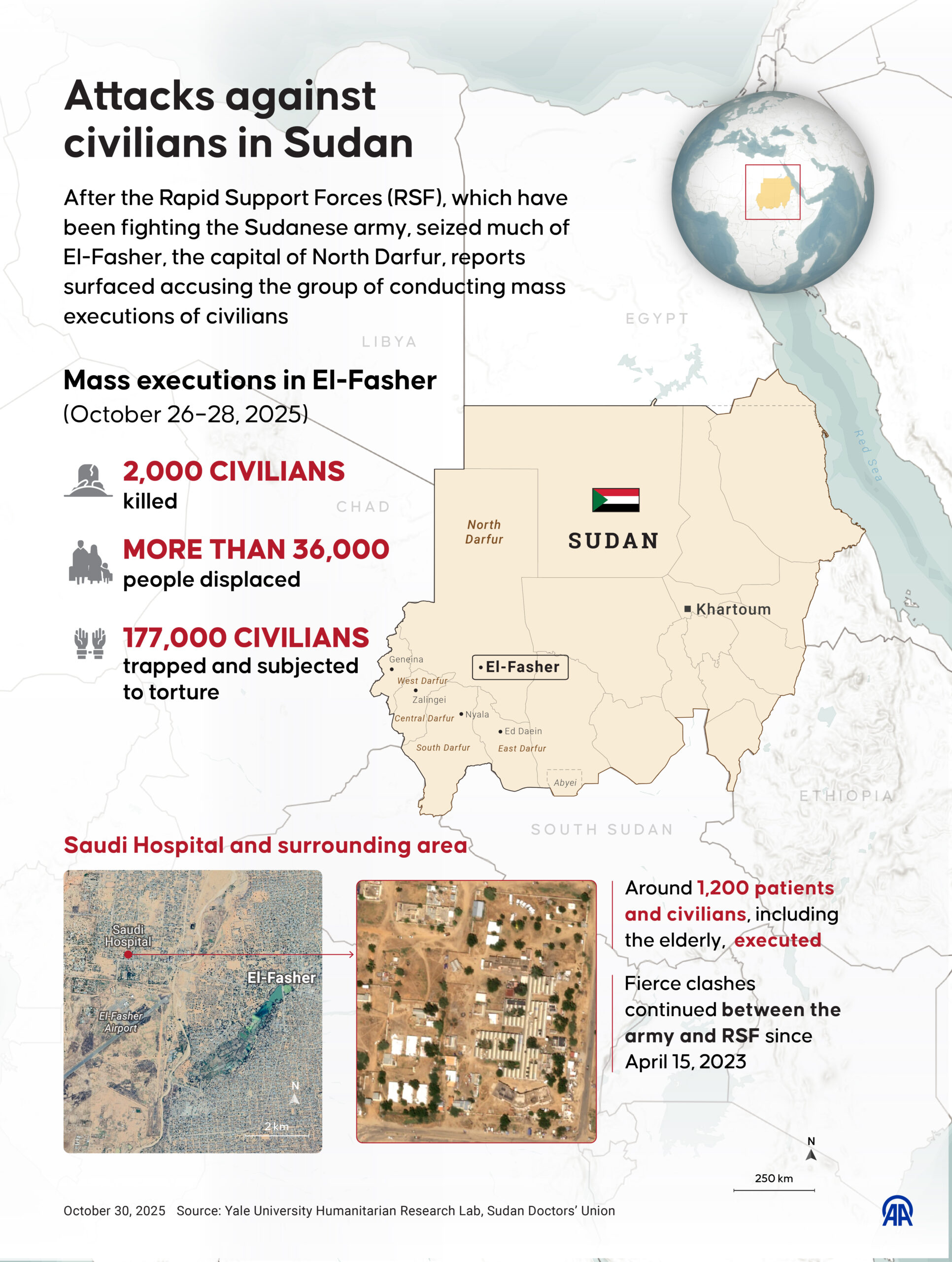
More than 250,000 civilians trapped in the city now face famine and targeted violence. Eyewitnesses and NGO reports describe racialised atrocities, including sexual violence, torture, and ethnically driven killings. International observers have characterised the attacks as war crimes, prompting growing calls for intervention.
The violence has revived comparisons with the Darfur genocide of the 2000s. The RSF itself evolved from the Janjaweed militias responsible for that campaign. In early 2025, the U.S. formally declared the RSF’s actions a genocide. Human Rights Watch and UNICEF have reported systematic ethnic cleansing, particularly against the non-Arab Massalit people, including the killing of children and the rape of women as weapons of war.
How did Sudan get here?
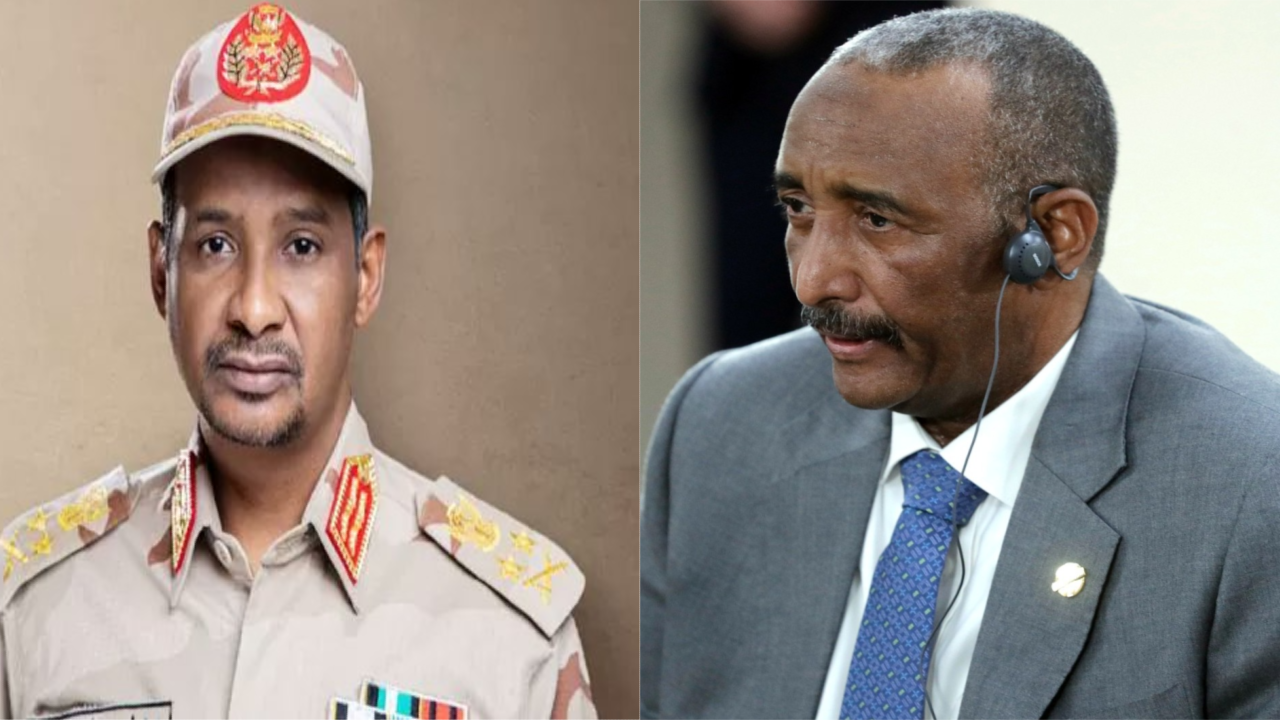
The current civil war erupted in April 2023 when a power struggle between Gen. Abdel Fattah al-Burhan, head of the Sudanese Armed Forces (SAF), and Gen. Mohamed Hamdan Dagalo—known as Hemedti—commander of the RSF, descended into open warfare.
Subscribe to our newsletter and stay updated on the latest news and updates from around the Muslim world!
The roots of the conflict trace back to the 2019 overthrow of longtime president Omar al-Bashir, which led to a fragile power-sharing agreement between military and civilian factions. That arrangement collapsed in 2021 when Burhan and Dagalo staged a joint coup against the transitional government.

Their alliance soon fractured over plans to integrate the RSF into the national army and disputes about who would command a unified force. By April 15, 2023, tensions erupted into full-scale war.
Since then, the conflict has killed more than 150,000 people and displaced over 14 million. The UN now considers Sudan the world’s worst humanitarian crisis, with famine and ethnic violence spreading unchecked.
Who are the RSF?
The RSF was formally established in 2013 but traces its roots to the Janjaweed militias infamous for their role in the Darfur genocide. Originally created to rein in Arab militias, the RSF soon became notorious for human rights abuses, including extrajudicial killings, rape, and forced displacement.
Led by Hemedti, a Darfuri Arab tribesman with no formal military training, the RSF grew rapidly in power and influence. Hemedti built a vast financial network through control of gold mining operations and regional smuggling routes, allowing him to arm and pay tens of thousands of fighters.
The RSF also gained combat experience abroad, deploying troops to Yemen and Libya in coordination with regional Gulf Arab powers like the UAE. Its involvement in policing migration routes to Europe even led to controversial cooperation with the EU. These factors combined make the RSF one of the most formidable paramilitary forces in Africa.
Foreign hands in Sudan’s war
Sudan’s conflict is being fuelled by powerful regional actors. Egypt backs the Sudanese army, citing border security and Nile water interests, while the RSF reportedly receives substantial support from the UAE and Libyan warlord Khalifa Haftar.
Khartoum accuses the UAE of arming and funding the RSF, including supplying drones and foreign fighters. The UAE denies the allegations, but Sudan has filed a case at the International Court of Justice (ICJ) accusing the Gulf state of complicity in genocide. Though the ICJ declined jurisdiction, the charges have intensified scrutiny of Abu Dhabi’s role.
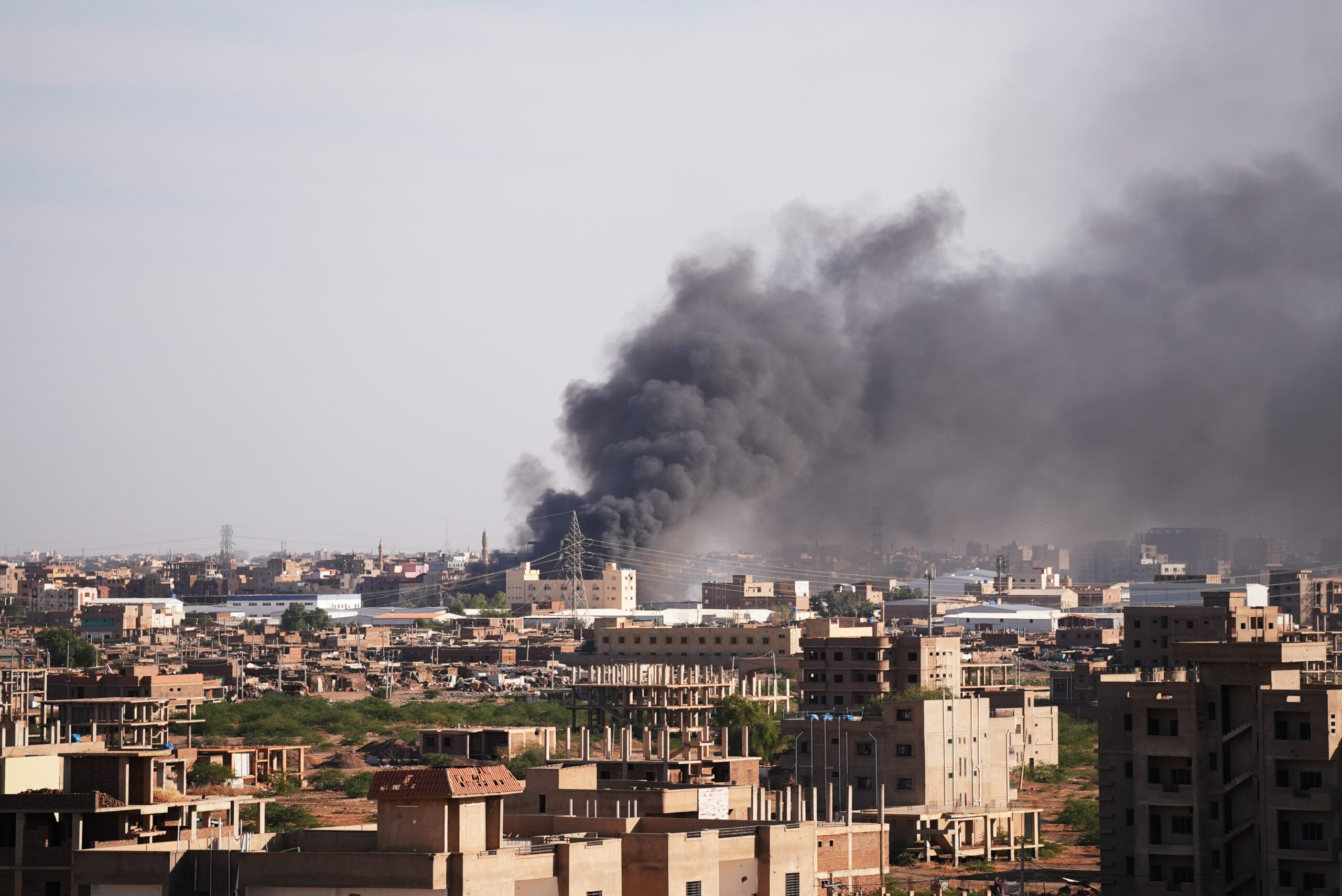
Reports have also linked Hemedti’s gold-smuggling network to the UAE, with Sudanese gold allegedly flowing into Dubai to fund the RSF’s operations. This has raised questions about international complicity and the lack of oversight in global gold markets.
Documents submitted to the UN Security Council and reported by The Guardian reveal that British-made military equipment has also reached RSF fighters. The dossiers—compiled by Sudanese army intelligence in June 2024 and March 2025—allege that small-arms targeting systems and vehicle engines manufactured in the UK were diverted through the UAE to RSF-controlled areas.
The findings have sparked criticism of the UK’s arms export regime, with campaigners accusing the government of negligence and indirect complicity in war crimes. The Foreign Office insists the UK operates one of the world’s most rigorous export control systems.
A nation on the brink
With the fall of El-Fasher and RSF control extending across much of Darfur and Kordofan, Hemedti’s forces have begun forming a parallel administration—raising the prospect of Sudan splitting once again, following South Sudan’s secession in 2011.
The Sudanese army still holds the north and east, including Port Sudan, which now serves as the temporary administrative capital. Although government forces regained Khartoum in March 2025, the city lies in ruins, with ministries, hospitals, and banks destroyed and infrastructure barely functioning.
The war has devastated Sudan’s economy. Over 24 million people face acute food insecurity, with aid agencies reporting widespread malnutrition and the collapse of food kitchens across the country. Humanitarian access remains heavily restricted despite repeated ceasefire talks.
Peace negotiations in Saudi Arabia and Bahrain have repeatedly failed to produce results. Both sides remain focused on military victory.
The Sudanese army, backed by Egypt, refuses compromise, while the RSF claims political legitimacy after recent gains.
The U.S. has imposed sanctions on both Burhan and Hemedti, and the UN has opened investigations into war crimes. Yet these measures have had little impact. Observers say the global community has effectively abandoned Sudan, dubbing it “the forgotten war.”
Humanitarian groups warn that Sudan is nearing total collapse. With millions displaced, cities destroyed, and famine spreading, the country risks permanent fragmentation and descent into warlord rule.