


Israeli Prime Minister Netanyahu vowed that Hamas will be disarmed as ceasefire begins but a senior Hamas official rejected the notion of total defeat, claiming the group will remain active on the ground.
According to ABC News, around 200 American soldiers have landed in Israel to establish a monitoring centre overseeing the ceasefire’s enforcement.
They will handle logistics, planning, transportation and engineering operations under the command of U.S. Central Command (CENTCOM) Admiral Bradley Cooper, and will not enter Gaza itself.
The mission will include coordination with units from regional countries.
The deployment follows U.S. President Donald Trump’s 20-point peace plan, unveiled on 29 September, which outlines a phased roadmap toward ending hostilities.

The first phase includes a permanent ceasefire, the release of Israeli captives in exchange for approximately 2000 Palestinian prisoners, and the gradual withdrawal of Israeli forces from the enclave.
A second phase envisions a new governing structure for Gaza without Hamas, the groups disarmament and the creation of a Palestinian-Arab security force.
Subscribe to our newsletter and stay updated on the latest news and updates from around the Muslim world!
Numbers alone cannot capture the toll that the war has taken on the Gaza Strip. Since October 2023, Israeli attacks have killed more than 67,000 Palestinians and wounded nearly 170,000, according to Gaza’s Health Ministry. Over 40,000 of the wounded have suffered life-altering injuries, and thousands more are believed to remain buried beneath the rubble.
The 2.1 million Palestinians living in Gaza have endured near-total devastation. Nine out of every ten residents are displaced, and at least three out of ten have gone days without food.
The World Health Organisation and Gaza’s Health Ministry report that more than 400 people, including over 100 children, have died from malnutrition-related causes, with famine conditions declared in Gaza City.

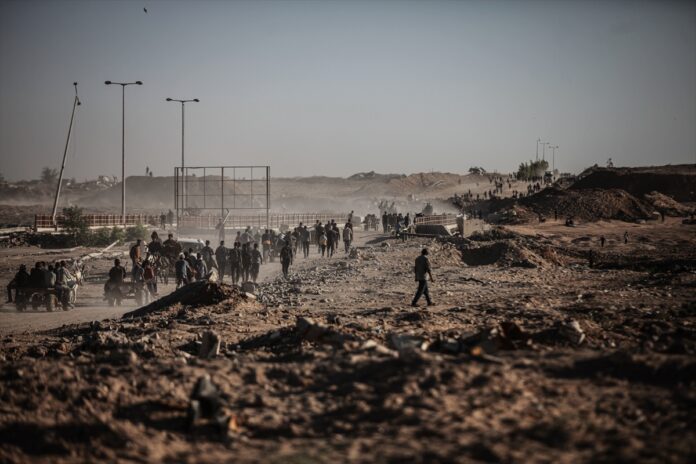
Entire towns have been levelled. Satellite imagery shows that more than 102 000 buildings have been destroyed, flattening schools, hospitals, mosques and homes. Agricultural land that once sustained the strip’s economy has been razed, leaving eight out of every ten acres of farmland destroyed.
Israel’s military now controls most of Gaza’s territory, pushing the civilian population into the southern coastal zones. Humanitarian agencies warn that reconstruction will require between 50 and 70 billion dollars, with Ahmed Bayram of the Norwegian Refugee Council saying the challenge “will be enormous” and dependent on Israel’s willingness to allow the rapid entry of construction materials.
Hamas: ‘We’re still there on the ground’
In an exclusive interview with Sky News, senior Hamas official Dr Basem Naim confirmed that Hamas will step aside to enable the Palestinian Authority to take over management of Gaza however rubbish claims that the group has been totally defeated by Israel.
“We are ready to hand over the government, we are totally ready to be away from any governing body, but when it comes to Hamas as an entity no one can over come or exclude Hamas. Hamas is also precent in the West Bank, in the Jerusalem, in the diaspora. There we are ready to leave the government but we are still there on the ground.”
Naim also suggested Hamas may not totally disarm or stop fighting Israel.
“We can transfer the weapons to the hands of a Palestinian state, and the fighters can be integrated into the Palestinian national army but until that happens, no one has the right to deny us our right to resist the occupation by any means.”
He also added thanks to President Trump for securing the deal but warned that former UK Prime Minister Sir Tony Blair would not be welcome in any post-war role for Gaza.
Trump’s Gaza deal strongly basis the agreement on the idea that Gaza will no longer pose a threat to Israeli security and that Hamas are unable to launch attacks such as was seen on 7 October.
Despite this, Hamas remains adamant that Palestinian resistance has not be beaten or suppressed and will continue.

Elsewhere, Italy has announced the resumption of its role in the European Union Border Assistance Mission (EUBAM) at the Rafah crossing between Egypt and Gaza. Defence Minister Guido Crosetto said the crossing would reopen on 14 October, alternating between entry to Gaza and exit to Egypt in coordination with the EU and regional parties.
Foreign Minister Antonio Tajani said Rome stands ready to deploy troops to assist the peace process. “We can send the Carabinieri, we can send army troops. We have Carabinieri who are already in Palestine, so they know the territory. If this request comes, we are ready to do our part to build peace and the Palestinian state of the future,” Tajani said.
With more than half of its population displaced, entire neighbourhoods flattened and key institutions in ruin, Gaza faces a recovery that experts warn could take decades, and cost billions of dollars.
A comprehensive Gaza and West Bank Interim Rapid Damage and Needs Assessment (IRDNA) report, released by the World Bank, EU and the UN in February, paints a grim picture, with estimated costs of $53 billion, with short-term needs in the first three years to be around $20 billion.
According to the assessment, evaluating the situation from October 2023 to January 2025, the estimated physical damages incurred are around $29.9 billion, and economic and social losses amounting to $19.1 billion.
Other estimates place the cost of reconstructing the enclave even higher than figures cited in the IRDNA report.
The Gaza Media Office put initial losses in vital sectors at more than $70 billion, in a statement Friday, demanding an urgent plan to rebuild.
EU urges swift action
The European Union welcomed the ceasefire plan and urged all sides to “fully implement the agreement without delay.”
In a statement by EU foreign policy chief Kaja Kallas, the bloc called the plan “a real chance to end the devastating war and the human suffering.”
Brussels praised the diplomatic efforts led by the US and supported by Egypt, Jordan, Saudi Arabia, Qatar, Türkiye and the UAE.
The EU reaffirmed its readiness to contribute to Gaza’s stabilisation and reconstruction through EUBAM Rafah and the EU Police Mission for the Palestinian Territories (EUPOL COPPS), in support of the Palestinian Authority’s potential return to Gaza.
As U.S. troops assemble to monitor the ceasefire and European partners re-engage diplomatically, the scale of destruction in Gaza raises doubts about how swiftly peace and recovery can be achieved.
Nearly the entire population has been displaced, thousands remain missing, and basic necessities such as food, water and healthcare are critically scarce.
With famine spreading, infrastructure in ruins and political uncertainty looming over Gaza’s governance, the international community faces a daunting task: turning the fragile ceasefire into the foundation for lasting stability and rebuilding a territory that has been left in ruins.