


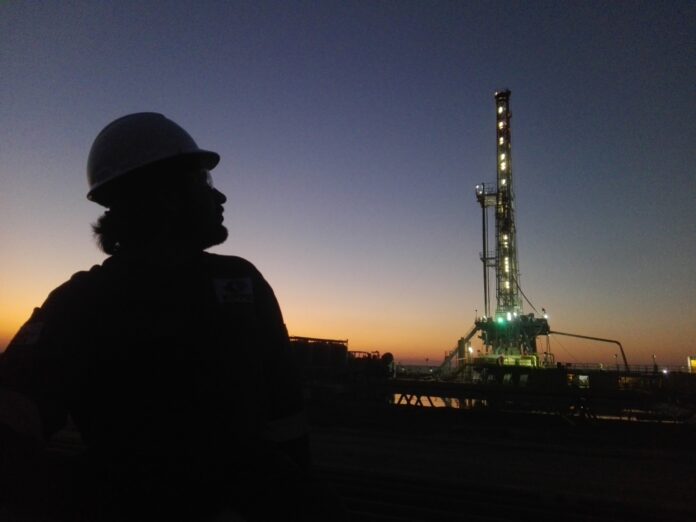
U.S. President Donald Trump said on Wednesday that his administration has struck a new landmark trade deal with Pakistan that includes joint development of the country’s “massive” oil reserves.
“We have just concluded a Deal with the Country of Pakistan, whereby Pakistan and the United States will work together on developing their massive Oil Reserves,” Trump wrote on social media.
“We are in the process of choosing the Oil Company that will lead this partnership. Who knows, maybe they’ll be selling Oil to India someday!” Trump said on his social media platform, Truth Social.
According to Pakistan’s Ministry of Finance, the breakthrough came during Finance Minister Muhammad Aurangzeb’s meeting with the U.S. Secretary of Commerce and Trade Representative.
“The purpose of the deal is to boost bilateral trade, improve market access, attract investment, and strengthen cooperation in areas of mutual interest,” the official statement said.

“Under the agreement, there will be a reduction in tariffs, particularly on Pakistani exports to the U.S., and a fresh start in economic cooperation between the two countries.
“The two sides will focus on energy, minerals, information technology, cryptocurrency, and other key areas, the statement added.
Subscribe to our newsletter and stay updated on the latest news and updates from around the Muslim world!
It added that the agreement would help grow Pakistan’s trade ties with the U.S. and improve access to each other’s markets. “It is also expected to draw more U.S. investment into Pakistan’s infrastructure and development projects.”
‘Diplomatic win’
Observers in Pakistan say that the country has scored a major diplomatic and economic win.
Muhammad Iqbal Jawaid, a Karachi-based oil industry expert, viewed the development as “encouraging” for Pakistan’s “untapped” oil and gas sector, which has a “huge” potential to grow.
“Pakistan enjoys a huge untapped potential for oil and gas, but it requires massive resources that we don’t have. If the U.S. comes into the picture, it could lead to a major breakthrough,” Jawaid told Anadolu.

The country’s southwestern Balochistan and northwestern Khyber Pakhtunkhwa provinces, along with tribal districts near the Afghanistan border, also have bright prospects in terms of oil and gas exploration, he added.
In addition, said Muhammad Iqbal Jawaid, the South Asian country has strong prospects of having offshore energy reserves, which could be tapped with the help of major global companies.
Sharing a similar view, Wasi Khan, another oil industry and energy expert, said Islamabad has not been able to tap its “true” potential in the oil and gas sector due to inadequate infrastructure and underinvestment.
“I see this development in a positive commercial context. Greater international cooperation in Pakistan’s energy sector can bring in more investment, advanced technology, and healthy competition, all of which serve Pakistan’s interests,” he told Anadolu.
Security challenges
Wasi Khan said that in Pakistan’s case, exploration efforts remained limited so far, primarily due to resource constraints and law and order challenges in onshore regions.
However, offshore areas are free from such limitations and represent a significantly underexplored frontier, he added.
Endorsing the opinion, Jawaid observed that the law and order in Balochistan and Khyber Pakhtunkhwa provinces needs to be improved to attract international investment in the local energy sector.
The restive South and North Waziristan tribal districts, together with other adjoining areas, are believed to have been sitting on major oil and gas reserves, which remain untapped due to security issues.
The two provinces, including the tribal districts, have long been the hotbed of militancy, where security forces are fighting against Tehreek-e-Taliban Pakistan, a consortium of several militant outfits, and ethnic Baloch separatists.
The mineral-rich Balochistan is also a key route for the multi-billion-dollar China-Pakistan Economic Corridor (CPEC) project.
Pakistan’s oil reserves
Pakistan’s proven oil reserves are currently estimated at 353 million barrels, according to the U.S. Energy Information Administration (UEIA).
Its current oil and condensate production stands at 60,000 barrels per day.
With an annual oil import bill of over 12 billion dollars, the South Asian country imports fuel mainly from Saudi Arabia, the United Arab Emirates, Qatar, Kuwait and China.
It has also started importing crude oil from Russia during the last few years, albeit on a smaller scale.
The UEIA once estimated that Pakistan holds up to nine billion barrels of technically recoverable shale oil. This assessment may well have formed the basis for President Trump’s remarks on Pakistan’s energy potential, according to Khan.
If approached with serious intent and supported by capable partners such as American expertise, he observed, Pakistan could embark on a transformative path, much like Saudi Arabia once did.
“There, five major US oil companies (Chevron, Texaco, Exxon, Mobil, and Gulf Oil) joined forces, eventually forming Aramco (the Saudi state oil company) and discovering one of the largest oil reserves in the world,” he added.
“Pakistan’s offshore potential deserves the same scale of ambition and commitment,” Wasi Khan further said, adding that he is “very hopeful” about the country’s untapped oil potential.