
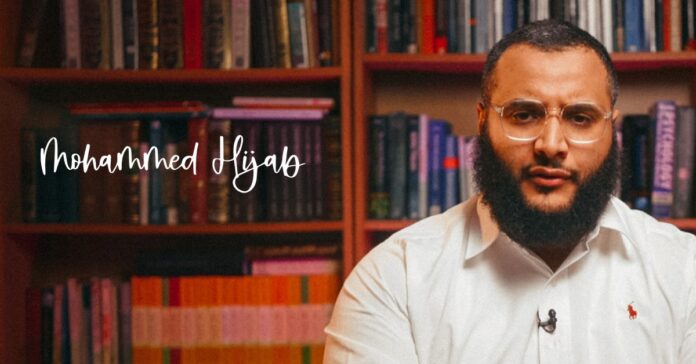
Prominent British Muslim influencer Mohammed Hijab says he is under criminal investigation after being questioned by police about his anti-Israel activism, while raising suspicions of possible Mossad interference in his life.
Hijab, who has millions of followers across social media, revealed that he attended a voluntary police interview under caution on October 31, during which he refused to answer questions about his activities relating to Israel.
In a video statement and a series of posts on X, Hijab also disclosed that counter-terrorism police had previously stopped him at Gatwick Airport, seized his electronic devices and examined thousands of private messages.
He suggested that a series of unusual incidents involving his family and personal life could be connected to Israeli intelligence agency Mossad, although he acknowledged that he could not establish whether the events were coincidental or connected.
Police interview

Hijab said he was invited to attend a voluntary interview under caution on October 12, two days after publicly accusing Mossad of interfering in his life. He attended the interview on October 31 and said he answered every question with “no comment” on legal advice.
“I was recently called in for a police interview under caution. I wasn’t arrested, but it was a criminal investigation and still is,” he said.
Subscribe to our newsletter and stay updated on the latest news and updates from around the Muslim world!
He declined to reveal the alleged offence under investigation but claimed that the questioning overwhelmingly concerned his public activism relating to Israel.
“The questions I answered no comment to, all of them, was a no comment interview,” he explained. “It was a lot of questions [that] were essentially, for the absolute most part, relating to anti-Israel activism actually, and some of the things that I had done or said publicly.”
Hijab said he was withholding further details for legal reasons.
A voluntary interview under caution does not constitute an arrest, although it means police are questioning an individual in connection with a suspected criminal offence. No charges against Hijab have been disclosed in the material he published.

Phone seized
Hijab also revealed that he had been stopped by counter-terrorism officers at Gatwick Airport on May 12 under Schedule 7 of the Terrorism Act 2000.
The legislation gives police extensive powers to question and examine people at ports and airports to determine whether they may be involved in terrorism. Such examinations do not require officers to have reasonable suspicion that the person has committed an offence.
In a post on X, Hijab wrote: “In May, counter terrorism police stopped me without explanation, seized my devices and read more than ten thousand messages. My phone came back on 11 September. No further questions.”
He published a heavily redacted letter, dated May 18, from Counter Terrorism Policing South East confirming that he had been examined at Gatwick Airport on May 12.
The letter informed him that the legal power being used to retain his seized property had changed. It also stated: “This does not necessarily mean you are currently under criminal investigation.”
He also published what he described as an extract from police notes obtained through a subject access request. The heavily redacted document, bearing Counter Terrorism Policing branding, contains a handwritten line stating: “Doesn’t want to be an informant.”
Suspicions of Mossad interference
Hijab also outlined a chronology of events that he suggested could point towards attempts to intimidate or interfere with him.
He began with a September 8 public debate against Jonathan Conricus, a former Israeli military spokesman. Three days later, while collecting his phone following the Schedule 7 examination, he said he experienced an unexpected encounter, the details of which he has not disclosed.
On September 30, Hijab claimed that a stranger approached him and revealed private information about his family. He said he had documented the encounter in contemporaneous notes and forwarded details to his lawyers.
He also referred to meetings with unnamed “stakeholders”, including one on October 7.
On October 9, a family vehicle was allegedly stolen, an incident for which Hijab said he possesses a police crime reference number.
The following day, October 10, he publicly accused Mossad of interfering in his affairs in a post on X. According to Hijab, the post attracted nearly one million views and 12,000 likes.
On October 12, he received the police invitation to attend a voluntary interview under caution.
Hijab presented the sequence as potentially significant but stopped short of claiming that it proved a coordinated operation.
“I’m not making any comments about what I think this means. People are free to make their own judgments,” he said. “If this is coincidental, if it’s not coincidental, if this is just correlational, if it’s causational, I’m not making a comment about any of that.”
Nevertheless, he said he had reasons to suspect Israeli intelligence involvement in at least some of the encounters, alleging that individuals had attempted to disguise their identities.
He referred to what he described as signs of Hebrew-language interference in their speech, but did not provide recordings or other evidence establishing the individuals’ identities.

‘Sensitive information’
In another part of his statement, Hijab claimed to have distributed sensitive information about incidents he had experienced to several individuals in Britain and overseas. He said the material had been stored on USB devices and other equipment without internet connectivity.
According to Hijab, some recipients had told him they would consider making the information public if they believed he was being persecuted. He stressed that he personally did not wish to release the material because of the potential legal and security consequences.
“I assure you these are things I would never choose to put out myself because of the legal and security risk associated with doing so,” he said.
He added that the individuals holding the devices had made their own decisions about what circumstances might justify disclosure.
“It’s no longer in my control,” he said.
Hijab did not disclose the contents of the material, and its existence, authenticity and relevance have not been independently established.
Defiant warning to Mossad
Hijab concluded his statement with a direct message to Mossad, insisting that any attempt to intimidate him would strengthen rather than weaken his commitment to the Palestinian cause.
“It’s an honour to be dishonoured by dishonourable people,” he declared.
He accused Israel of being a “belligerent, transgressive, apartheid state” and insisted that Israeli intelligence had no right to interfere in British affairs.
Addressing the wider British public, he warned that any proven foreign intelligence interference against political activists should concern people regardless of whether they agreed with his views.
“I know that many of you don’t agree with my views,” he said. “But if you stand for something like this, if it is the Mossad doing all those other things that I’ve mentioned in the timeline, then the next person is going to be you because if you give them an inch, they will take a mile.”