

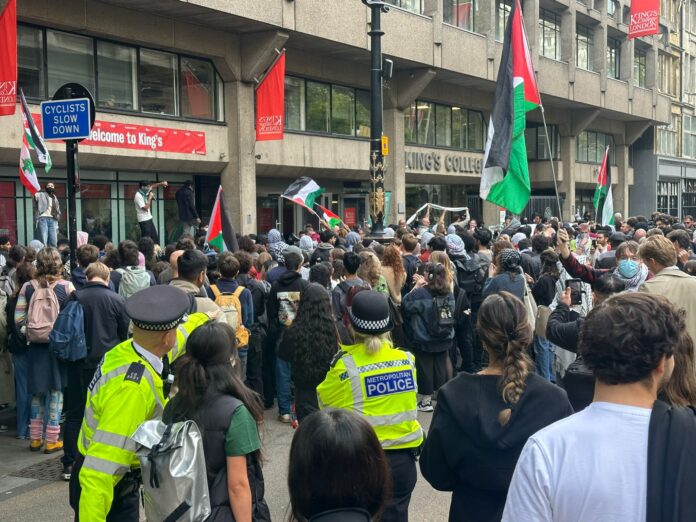
British universities have been accused of systematically suppressing pro-Palestinian activism, with students and academics facing suspensions, campus bans, disciplinary investigations and even threats to their visa status for expressing solidarity with Palestinians.
A major new report published by Amnesty International today reveals how universities across the UK have restricted freedom of speech and peaceful protest in response to demonstrations against Israel’s war on Gaza.
The report, titled Silencing Dissent, documents cases in which students faced disciplinary action for activities as minor as chanting, clapping and wearing Palestinian keffiyehs.
Amnesty found that universities had cancelled events, dismantled protest encampments, banned individuals from campuses and used disciplinary procedures to discourage political activism.
The human rights organisation concluded that many of these restrictions failed to meet the legal standards required to justify interference with freedom of expression and peaceful assembly.

Kerry Moscogiuri, chief executive of Amnesty International UK, condemned the findings, saying: “This is an attack on our freedom of speech and the right to protest from the very institutions who are supposed to encourage free thought.”
Muslim and Palestinian students disproportionately targeted
Subscribe to our newsletter and stay updated on the latest news and updates from around the Muslim world!
The investigation examined events between October 7, 2023, and September 30, 2025, drawing on 26 university case studies and interviews with students and academics.
One of the report’s most concerning findings is that Palestinian, Arab and Muslim students, particularly those visibly identifiable through their clothing or expressions of Palestinian identity, have been disproportionately affected by university restrictions.
International students have faced additional pressures because disciplinary proceedings could threaten their immigration status and ability to remain in Britain.
Among those highlighted is 22-year-old Usama Ghanem, who was suspended by King’s College London in 2025 over his involvement in pro-Palestinian activism.
Ghanem, an Egyptian student who had previously experienced detention and torture in Egypt, was told to return to his home country during his suspension. His suspension was eventually lifted following a review in September 2026.
Ghanem said he had fled repression in Egypt only to encounter similar treatment at a British university.
He alleged that King’s had also disciplined 25 other students involved in Palestinian solidarity activities and accused the institution of attempting to intimidate protesters into silence.
Oxford, Cambridge and LSE criticised
The report highlights several prominent British universities, including Oxford, Cambridge and the London School of Economics (LSE).
At Oxford, students established protest encampments in May 2024 demanding that the university withdraw investments from companies supplying weapons to Israel.
According to Amnesty, the university responded by involving police, launching lengthy disciplinary investigations and restricting some protesters’ access to libraries, buildings and other university facilities.
At Cambridge, university authorities sought a court injunction in March 2025 to restrict pro-Palestinian demonstrations at several prominent campus locations.

Editorial credit: Stan Halcin / Shutterstock.com
The university cited safety, public order and reputational concerns, but critics argued that the proposed restrictions were excessively broad and threatened legitimate peaceful protest.
At LSE, seven students were banned from campus after staging a brief demonstration in July 2024 calling for divestment from companies supplying arms to Israel.
The protesters wore keffiyehs, displayed red handprints and chanted slogans during a demonstration lasting approximately 15 minutes, according to the students, although LSE said it lasted 25 minutes.
Amnesty reported that internal university communications described the demonstration as a “temper tantrum by children”, while some students were reportedly characterised as being dressed as terrorists.
The campus bans also restricted access to in-person welfare services, although LSE subsequently adjusted the arrangements.
The university has maintained that the demonstration raised concerns partly because it took place on the anniversary of the July 7 London bombings.
Government pressure and coordinated restrictions
Amnesty also raised concerns that the suppression of Palestinian solidarity was not confined to individual university administrations.
Its investigation found evidence of institutions sharing legal strategies and security arrangements, while government pressure, regulatory guidance, lobbying organisations, private law firms and security contractors influenced their responses.
Some universities had received instructions from the Department for Education, according to the report.
Amnesty argued that this contributed to a wider environment in which peaceful demonstrations were increasingly treated as security threats rather than legitimate expressions of political opinion.
The organisation also raised concerns about the potential use of counter-terrorism measures against Palestine-related activism.
However, universities have defended their responsibility to protect students and staff from harassment and intimidation.
Universities UK has emphasised that institutions must balance freedom of expression with campus safety and their legal obligations, while insisting that restrictions on demonstrations should not discriminate against particular political viewpoints.
Amnesty demands action
Amnesty is now calling on universities across Britain to adopt its Defend Dissent Charter, which seeks to protect students’ rights to organise, protest and express political disagreement without facing disproportionate punishment.
The campaign is already being supported by student organisers at 20 universities.
The organisation says university leaders must recognise peaceful protest as a fundamental right rather than a disciplinary problem.
The findings come amid wider concerns about restrictions on pro-Palestinian activism in Britain, including the use of counter-terrorism legislation against protesters and legal measures restricting demonstrations.
Amnesty argues that the treatment of students and academics reflects a broader erosion of civil liberties at a time when universities should be protecting freedom of expression and encouraging debate on controversial political issues.