




The UK High Court has ruled that the government’s ban on the anti-Israel group Palestine Action was unlawful.
The decision came after co-founder Huda Ammori challenged the ban in court, saying it disproportionately infringed on rights to freedom of expression and assembly.
However, Palestine Action will remain a proscribed organisation pending a government appeal.
The government’s order, made in July 2025 under the Terrorism Act, had placed Palestine Action on the same terrorism list as groups such as al-Qaeda and ISIS, criminalising membership or support with penalties of up to 14 years’ imprisonment.
Since the ban, thousands of arrests have been made at demonstrations and in relation to showing support for the group.

Judges found that the ban was not justified and that it involved a disproportionate interference with civil liberties, but they allowed the proscription to remain temporarily in effect to give both sides time to consider whether to appeal the ruling.
The High Court said that when the former Home Secretary Yvette Cooper decided to ban the organisation last June, she had failed to first take into account what impact that decision would have on the right to protest.
Subscribe to our newsletter and stay updated on the latest news and updates from around the Muslim world!
They also said she had not fully followed her own policies regarding the test for when an organisation should be proscribed under the Terrorism Act.
“We accept that the fact of proscription and the heavy penalties for [terrorism offences] will mean that it is reasonable to expect people to be risk averse, to adjust their behaviour and to avoid doing things that run any significant risk that they might commit any of those criminal offences,” Dame Victoria Sharp said.
The judges said that while “a very small number” of Palestine Action’s activities met the legal test for acts of terrorism, the standard criminal law could be used to confront the group.
Reaction
Activists welcomed the decision, calling it a landmark for protest rights and political dissent, while the government is expected to review its next legal steps, including a possible appeal to the Court of Appeal.
CAGE International said the ruling represents a decisive rejection of attempts to shield corporations complicit in arming the genocide in Gaza and follows significant public pressure that compelled the judiciary to force this policy reversal.

This ruling against the Home Secretary’s decision should now result in the withdrawal of charges against all Palestine Action activists in prison and the thousands who acted on their conscience as part of the largest civil disobedience campaign this country has seen in recent years.”
But Home Secretary Shabana Mahmood said she is “disappointed” by the High Court’s decision.
“For those reasons, I am disappointed by the Court’s decision and disagree with the notion that banning this terrorist organisation is disproportionate.
She added that the government’s proscription “followed a rigorous and evidence-based decision-making process, endorsed by Parliament”.
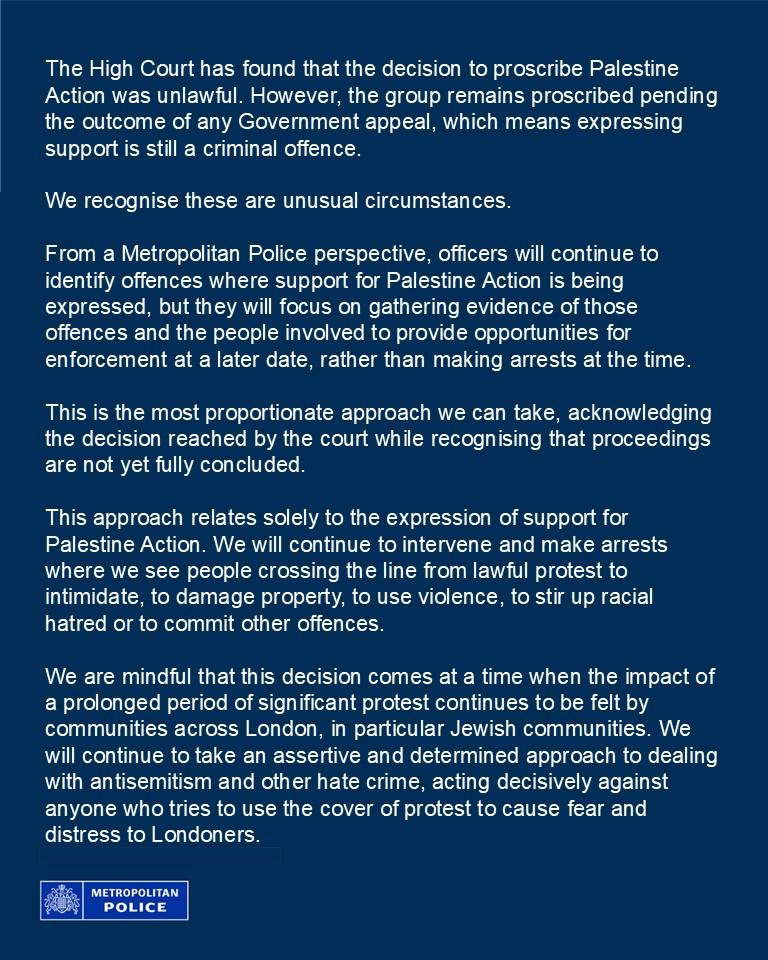
Meanwhile, the Metropolitan Police said they would stop making arrests of those who expressed support for Palestine Action, but would instead “gather evidence” in case of future prosecutions.
Why was Palestine Action banned?
Supporting Palestine Action became illegal in July 2025 after the government voted to proscribe it under anti-terror law.
It meant that membership or expressing support for the group became punishable by up to 14 years in prison.
The move came weeks after Palestine Action activists broke in to an RAF base and spray-painted two military aircraft, resulting in £7m of damage.
At the time, the government said the group met the criteria for terrorism, which is the use or threat of violence or damage to property designed to influence a government or intimidate the public to advance an ideological cause.
The proscription of Palestine Action in July 2025 drew widespread condemnation from legal experts and civil liberties organisations, who warned that such measures represented a dangerous escalation in the criminalisation of political dissent.
This ruling follows last week’s acquittal and non-conviction of the six “Filton 24” activists held under counter-terror powers for dismantling weapons destined for Gaza. Together, these cases demonstrate that organised resistance is the true check on state power.
More to follow…