



A letter has been delivered to the Home Office informing them of a planned hunger strike by pro-Palestine prisoners linked to the proscribed group Palestine Action, set to begin in November, adding pressure amid ongoing protests against the group’s ban.
The prisoners are members of the Filton 24 and Brize Norton 5 who are being held in prison, unconvicted, accused of taking part in two separate actions, claimed by Palestine Action.
According to the letter, the prisoners will start their hunger strike on 2 November, on the anniversary of the Balfour Declaration, and just two weeks before the start of the first of the Filton 24 trials.
The hunger-strike aims to highlight the allegedly poor conditions the prisoners face in incarceration, and set out a series of demands to the British government which includes: “the right to a fair trial, release on bail, and the dropping of all terror-related charges.”
Two previously imprisoned activists, Francesca Nadin and Audrey Corno, who are now part of the Prisoners for Palestine collective, who advocate for the prisoners, handed the letter announcing the protest to the Home Office on Monday.

They told 5Pillars: “This is a historic moment. The government must make the correct decision and give the prisoners the basic legal rights that they have been denied. The government has left the prisoners with no other option but to hunger strike for their freedom and justice.”
“The prisoners are firm in the knowledge that they have massive support both here and internationally, and that the people will come together to take action in their name. This is a direct result of not only the government’s appalling actions towards the prisoners, but also their active participation in the genocide in Gaza.”
Subscribe to our newsletter and stay updated on the latest news and updates from around the Muslim world!
Dr Asim Qureshi, Research Director at CAGE International, who are also acting as negotiating partners for the prisoners alongside Prisoners for Palestine, said: “This hunger strike, if it goes ahead, will be the first of its kind in at least two decades. It brings into sharp focus the violence of the carceral system in the UK, a violence we often associate with places afar.
“From Guantánamo to Gaza, the infrastructure of authoritarian terror laws built to imprison, silence, and suppress action for Palestine and voices challenging wars and genocide must be dismantled. Prisoners are the beating heart of our movement for justice. We must honour their sacrifices and stand up to challenge the injustices they face.”
There are currently 33 prisoners being held on remand in British prisons for Palestine-related actions.
The Filton 24
The Filton 24 are a group of activists who have all been imprisoned in relation to a Palestine Action raid on the Research, Development, and Manufacturing Hub of Israel’s biggest weapons maker Elbit Systems, located at Filton, Bristol.
In the action, which took place in August 2024, a group of activists drove a modified prison van through the facility’s perimeter fence, and on through the shuttered entrance.
Six activists then entered the building, and began dismantling production machinery, as well as Elbit-produced quadcopter drones, which have reportedly been used throughout the Gaza genocide.
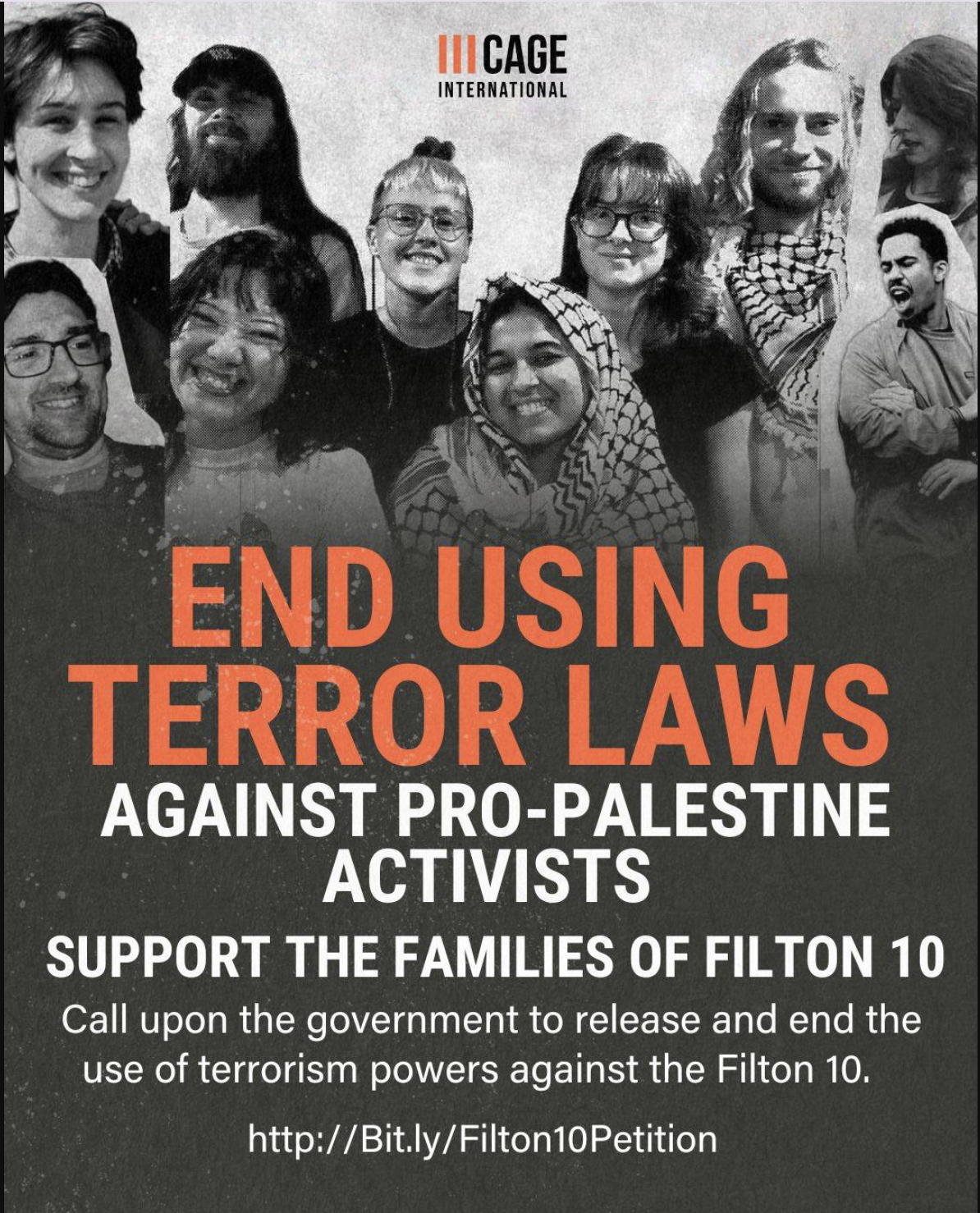
The six activists were arrested at the site, but later, while in police custody, they were re-arrested under counter-terrorism legislation, which allowed the authorities to extend their detention period.
They were later charged with non-terror related offences, and remanded in custody.
Over the following months, in a series of dawn raids, a further eighteen activists were arrested, often along with family members, who were later released.
The police again used counter-terror laws, and while they have never been charged with terrorist offences, the prosecution have alleged a “terrorism connection.”
According to Cage International, the Filton 24 have been “denied bail, and been subject to various abuses by the prison authorities, such as the withholding of mail.”
The treatment of the Filton 24 has been condemned, including by the United Nations.
In January, four UN special rapporteurs wrote to the UK government to raise concerns about the misuse of counter-terrorism measures to target Palestine Action activists and impose harsher detention conditions on them.
Appealing the proscription
This month, the government failed in its attempt to block a legal challenge against its decision to ban Palestine Action under terrorism laws.
In a highly significant ruling, the Court of Appeal paved the way for the review of the ban before a High Court judge next month after the co-founder of Pal Action, Huda Ammori, had won permission earlier this year for that judicial review of the home secretary’s ban.
The Home Office said it would consider the implications of the ruling, but said Palestine Action remained a proscribed group and those who support them will “face the full force of the law.”
Since the group was outlawed central London has witnessed numerous protest actions involving hundreds of activists flouting the law and peacefully expressing support for the group by holding up signs which read: “I oppose genocide, I support Palestine Action.”

( Raşid Necati Aslım – Anadolu Agency )
The protests have led to mass arrests but show little sign of abating despite promises from the authorities that anyone showing support for the group will be met with stiff punishments.
Activists taking this stand include pensioners, Christian priests and other religious activists, wheelchair-bound civilians and students.
The ban, which started on 5 July, makes membership of, or support for, the direct action group a criminal offence.
The ban was implemented in June after activists entered RAF Brize Norton, and sprayed blood-red paint on 2 Voyager aircraft leased by the RAF.
Brize Norton has allegedly served as a transport and re-fuelling hub for flights to RAF Akrotiri in Cyprus, from where daily flights have been dispatched to spy over Gaza.
The Brize Norton action was cited by former Home Secretary, Yvette Cooper, in proscribing Palestine Action as a supposed terrorist group, though in fact evidence shows proscription had been planned for some time previously.
With some of these prisoners now having spent over a year in custody, without trial, and with their treatment having allegedly deteriorated following the proscription of Palestine Action, they have opted to go on hunger-strike to “fight for fairer treatment.”
A hunger strike will add a new layer of pressure on the government who took the step to proscribe the protest group despite widespread criticism from politicians, activists and journalists.