



U.S. President Donald Trump unveiled a 20-point “peace plan” outlining a future for post-war Gaza at a White House conference with Israeli Prime Minister Benjamin Netanyahu on Monday.
Minutes before President Trump and Israeli Prime Minister Netanyahu appeared at a press conference on Monday evening, the White House released its 20-point plan to end the genocide in Gaza.
Netanyahu agreed to end Israel’s war on Gaza, with Trump saying that the move would be the Israeli leader’s “crowning achievement” if realised.
“It means the immediate end to the war itself,” Trump said at the press conference.
Netanyahu responded: “I support your plan to end the war in Gaza which achieves our war aims. It will bring back to Israel all our hostages, dismantle Hamas’s military capabilities, end its political rule and ensure that Gaza never again poses a threat to Israel.”

However, Netanyahu added that Israel “will finish the job” if Hamas rejected the plan or didn’t follow through with its commitments.
Trump said that he expects a “positive” response from Hamas, but Hamas has yet to respond.
Subscribe to our newsletter and stay updated on the latest news and updates from around the Muslim world!
Hamas
Qatari Prime Minister Sheikh Mohammed bin Abdulrahman Al Thani and Egypt’s intelligence chief Hassan Mahmoud Rashad met with Hamas negotiators to share the plan this morning.
The Hamas negotiators have said they would “review it in good faith” and provide a response in due course.
The 20-point plan proposes to “de-radicalise” Gaza into a “terror-free zone”, with no role for Hamas in its future governance, as well as to redevelop the Gaza Strip “for the benefit of its people”.
A new “Board of Peace” will also be established to oversee and supervise the transition of post-war Gaza, which will include former UK Prime Minister Tony Blair.
As for the foreign reaction from other Muslim and Arab countries, Saudi Arabia, Jordan, UAE, Pakistan, Turkey, Indonesia, Qatar, and Egypt all welcomed the plan and announced their willingness to cooperate to enforce it.
Key terms of the 20-point plan
Of the 20-point plan, these were some of the most significant conditions:
- Gaza will be a deradicalised terror-free zone that does not pose a threat to its neighbours.
- Gaza will be redeveloped for the benefit of the people of Gaza, who have suffered more than enough.
- Within 72 hours of Israel publicly accepting this agreement, all hostages, alive and deceased, will be returned. Once all hostages are released, Israel will release 250 life-sentence prisoners plus 1,700 Gazans who were detained after 7 October 2023, including all women and children detained in that context. For every Israeli hostage whose remains are released, Israel will release the remains of 15 deceased Gazans.
- Once all hostages are returned, Hamas members who commit to peaceful co-existence and to decommission their weapons will be given amnesty. Members of Hamas who wish to leave Gaza will be provided safe passage to receiving countries.
- Entry of distribution and aid into the Gaza Strip will proceed without interference from the two parties.
- Hamas and other factions agree not to have any role in the governance of Gaza, directly, indirectly, or in any form. All military, terror, and offensive infrastructure, including tunnels and weapon production facilities, will be destroyed and not rebuilt.
To add to the point above, the agreement also stated that it would effectively end the role of the controversial and scandalous Gaza Humanitarian Foundation (GHF), and give the responsibility to distribute aid to the United Nations and its agencies.
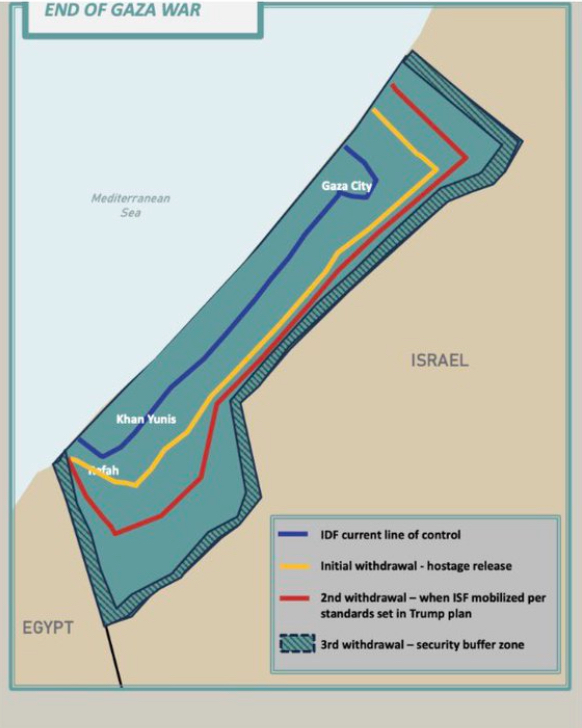
Other significant terms included that Israel will not occupy or annex Gaza as it previously stated it would, as well as the establishment of a temporary International Stabilisation Force (ISF) to be immediately deployed into Gaza.
The ISF would provide support and train Palestinian police forces in Gaza, and act as a long-term internal security solution, cooperating with Egypt and Jordan.
Netanyahu also said this morning that the IDF “will remain in most of the territory” as part of the plan drawn up by Trump, and that Israel did “absolutely not” agree to a Palestinian state, somewhat contradicting Trump’s plan.
New governance of Gaza
The US outlined that a new committee will temporarily govern Gaza with direct oversight from the “new international transitional body, called the ‘Board of Peace’”.
The White House has said that this Board of Peace will be headed by President Trump.
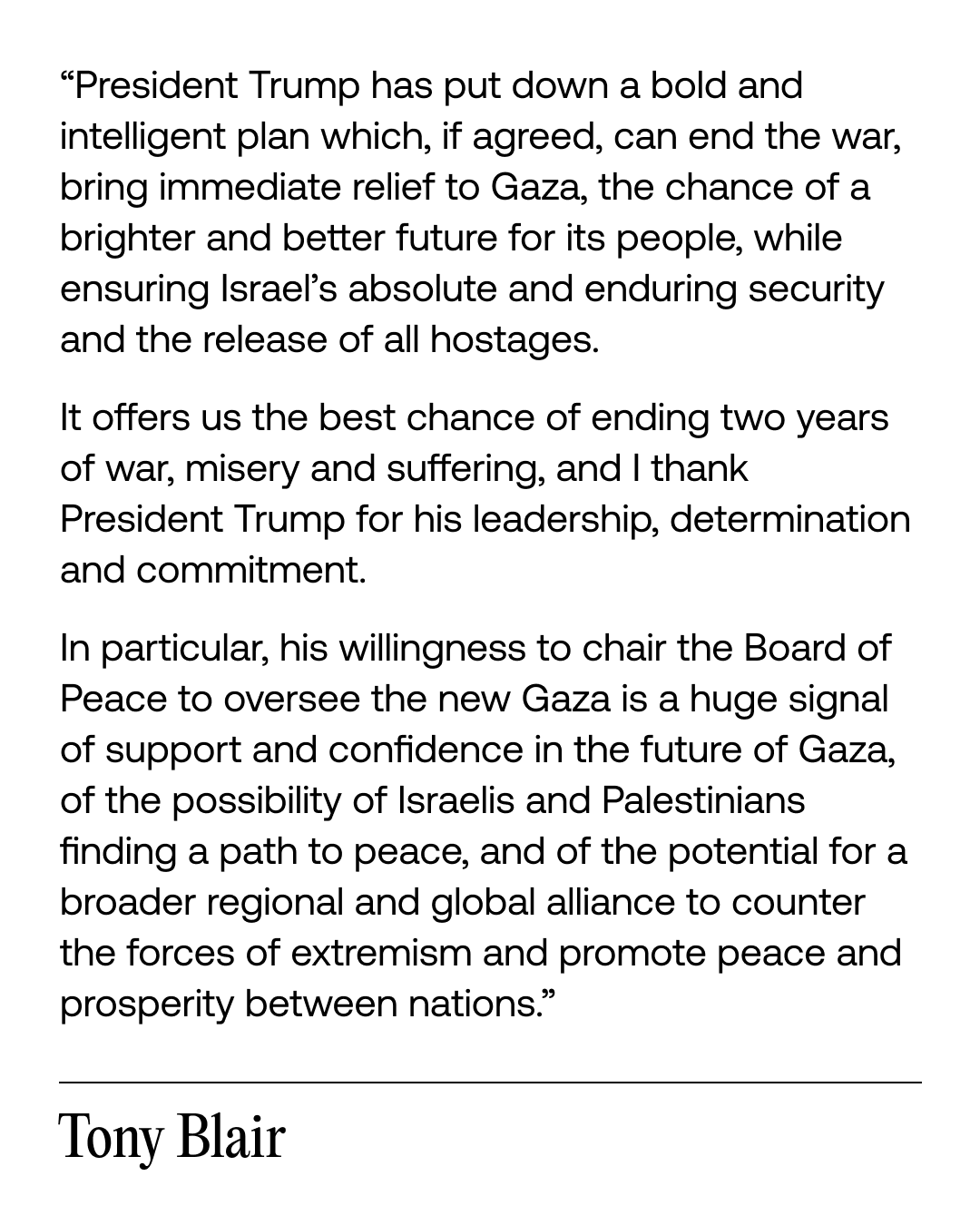
Tony Blair who described the plan as “bold and intelligent”, will be a part of this governing body, alongside other leaders who are yet to be announced.
Netanyahu praised Trump for offering to manage the enclave as “Chairman of the Board”.
“The fact you are taking this on helps a lot,” Netanyahu said to Trump.
Hamas or the Palestinian Authority (PA) would not be included in the “peaceful civilian administration” that would run Gaza.
Adding to this, Netanyahu said: “The PA can have no role in Gaza without undergoing a radical transformation”.
Reactions from Arab and Muslim governments
In a joint statement, foreign ministers of Saudi Arabia, Jordan, UAE, Pakistan, Turkey, Indonesia, Qatar and Egypt welcomed Trump’s Gaza ‘peace plan’ and announcement, saying they were ready to cooperate positively with the US and the relevant parties to finalise the agreement and ensure its implementation.

The statement affirmed the countries’ “joint commitment” to implement the plan.
Whilst Hamas has yet to respond, other armed Palestinian groups have, including Palestinian Islamic Jihad (PIJ).
PIJ’s Secretary-General Ziyad Nakhaleh strongly condemned it as a “continuation of aggression against the Palestinian people.”
He said: “With this, Israel is trying to impose through the United States what it could not achieve through war.
“Therefore, we consider the American-Israeli announcement a recipe for igniting the region.”
Various European leaders have praised the plan, including UK Prime Minister Sir Keir Starmer.
France and Italy also expressed their willingness to help facilitate and implement the peace plan.
As it stands, 66,005 Palestinians have been killed in Gaza, and 168,162 wounded since October 2023.
Today alone, Israel has killed at least 30 Palestinians as Hamas reviews the plan and the international community awaits a final response.